



Compliance
Top 9 Compliance Tools for Healthcare Facility Managers in 2027

November 5, 2026

10

On this page

Key Takeaways
- Facility compliance splits into life safety testing and environmental monitoring.
- Network setup decides deployment speed. Some tools use hospital Wi-Fi, and others run their own network.
- The survey record is the deliverable, so check how each tool documents tests and corrective actions.
- Hexmodal covers both categories on one platform. It runs on its own LoRaWAN and cellular network, so devices stay off hospital Wi-Fi and Ethernet. Among the nine tools here, the other eight each cover one category.
In 2023, two of the five requirements hospitals found hardest to meet involved the building itself, according to Joint Commission. One focused on ventilation in critical care areas, including room pressure and humidity. The other covered whether indoor spaces were safe and suitable for patient care.
Healthcare facility compliance software helps facilities teams test building systems, monitor conditions and keep records ready for surveyors. It is a different category from Health Insurance Portability and Accountability Act (HIPAA) privacy and training tools, which this list does not cover.
Facilities managers often have to look through separate checklists to stay on top of these requirements. One covers emergency lights and exit signs, while another tracks pharmacy refrigerators and pressure rooms. Each checklist may involve a different vendor, making reports harder to manage in a consistent way.
What Healthcare Facility Compliance Software Covers
Hospitals answer to several bodies for the condition of their buildings, and the software on this list helps prove compliance to each of them.
Hospitals must keep the physical plant and equipment maintained so patient safety is assured. That rule sits in the Centers for Medicare & Medicaid Services (CMS) Conditions of Participation. The Joint Commission covers the same ground in its Physical Environment chapter. DNV, a hospital accrediting organization, reviews it in annual surveys. Many of the underlying tests come from National Fire Protection Association (NFPA) codes.
For a hospital campus, that work falls into two categories.
- Life safety testing: Emergency lights and exit signs, with the test records behind them.
- Environmental monitoring: Cold storage temperatures and room conditions such as pressure.
What to Look for in Healthcare Facility Compliance Software
Six questions separate one tool from another, and each one is worth raising on a demo call.
- Coverage: Which compliance categories does the tool handle? Every extra vendor adds a login and a report format. It also adds a contract to renew.
- Automation: Does the system run the test, or does a person still walk the building? Digital records and automated testing save very different amounts of labor.
- Network: Does the tool need hospital Wi-Fi or Ethernet? Will it need an IT review? In many health systems, IT approval sets the deployment timeline.
- Documentation: Are records time-stamped and searchable? Are reports formatted for the authority having jurisdiction (AHJ)? The survey record is what you are buying.
- Workflow: Do alerts route by building or user group? Do they reach your computerized maintenance management system (CMMS)? Alerts that land in the wrong inbox only add noise.
- Commercial model: What sits inside the price, and what costs extra? Hardware and calibration change the total cost. So do implementation and support.
The table below turns each criterion into a question you can put to any vendor.
Table 1. Six criteria for comparing hospital compliance software, with the question to ask each vendor.
For a single building, one strong tool per category can work. For a multi-site health system, each added vendor repeats across every building, so coverage across both categories matters most at that scale.
See what automated testing would cover in your buildings.
The 9 Healthcare Compliance Companies at a Glance
The table below puts the nine tools side by side, using each vendor's own published pages.
Table 2. Coverage, automation and network model for nine healthcare compliance companies.
Two patterns stand out when you read the table.
- Single-category tools double up: A health system with both obligations runs two vendors and two dashboards. Its report formats double too, and the overhead grows with every building.
- The network column is the fastest filter: When comparing healthcare facility compliance software, start here. Tools on hospital Wi-Fi or Ethernet usually need IT approval before install. Tools on their own network can often move straight to deployment.
1. Hexmodal
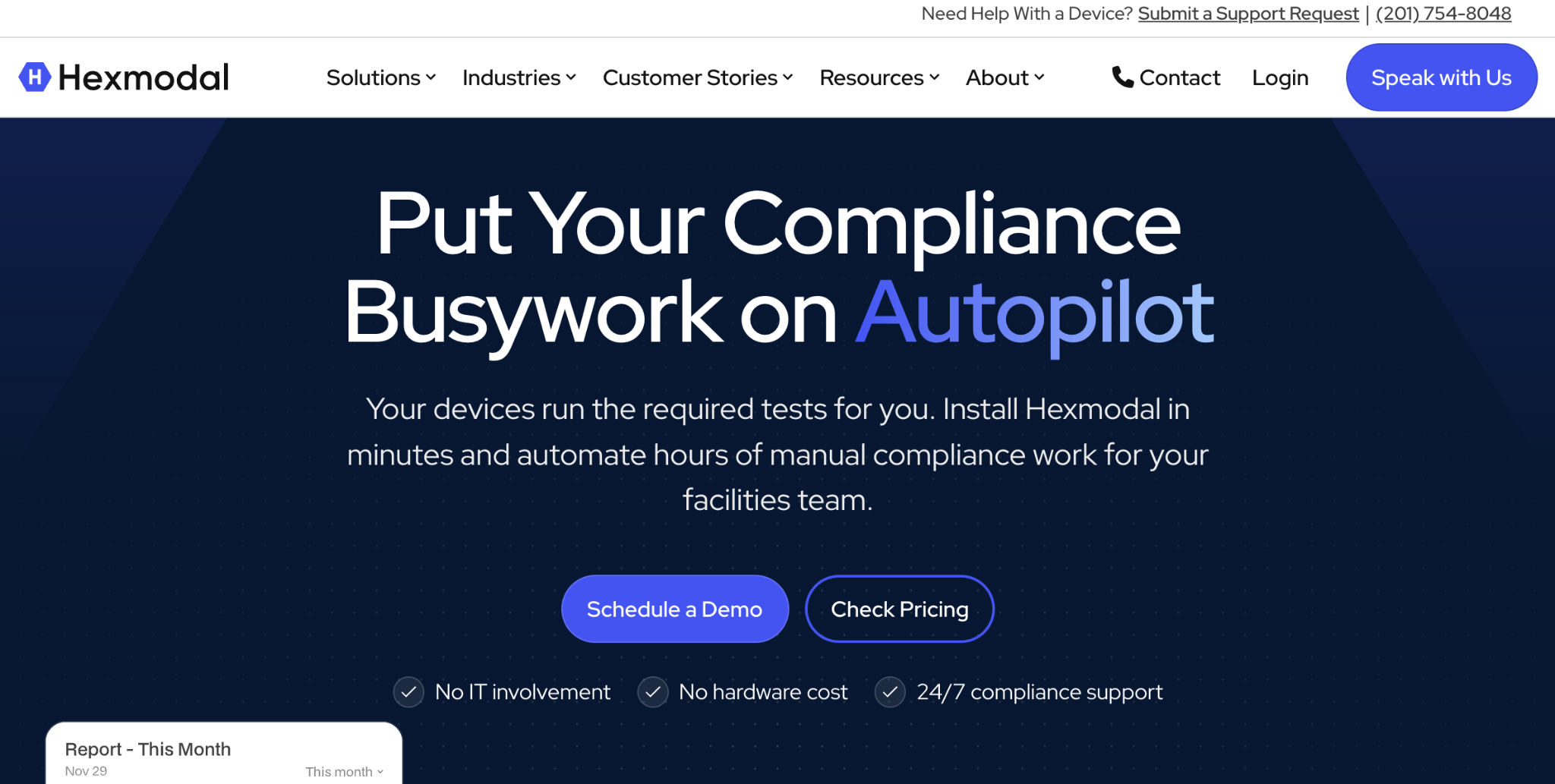
Best for: Health systems that carry both life safety and environmental obligations across hospitals, outpatient clinics and medical office buildings (MOBs).
Hexmodal is a managed compliance automation platform. It tests and monitors life safety and environmental systems, then produces the records surveyors ask for. Every product runs on its own LoRaWAN and cellular network, so devices stay off hospital Wi-Fi and Ethernet.
What it covers
Hexmodal runs four device products, and each one replaces a manual check or fills the gap between checks.
- Smart emergency lights and exit signs: Devices run the NFPA 101 monthly 30-second test and annual 90-minute test automatically.
- Smart room environment monitoring: Sensors track room pressure differential and temperature, with custom thresholds for each space such as operating rooms (ORs) and isolation rooms.
- Smart temperature monitoring: Sensors are NIST-traceable, with recertification at no cost. NIST is the National Institute of Standards and Technology.
- Smart leak detection: Point sensors trigger on as little as 0.2 inches of water, and zone cables cover tanks and pipe runs.
Benefits for healthcare facilities
Hexmodal's main advantage is coverage of both categories without a hospital network project.
- Results in the field: AdventHealth Fish Memorial and DeLand cut annual testing costs by 55%. Atlantic Health saved 10,050+ hours a year on compliance testing.
- Survey-ready records: Every emergency light test produces a report formatted for AHJ (Authority Having Jurisdiction). Records sit in a searchable Digital Binder.
- One subscription: Pricing is one annual per-device subscription with unlimited users. It covers devices and gateways with cellular data.
What "no IT required" means in practice
Your facilities team skips:
- No network credentials
- No firewall rules or Wi-Fi provisioning
Your facilities team still handles:
- The physical install during maintenance rounds
Before you buy
A few steps stay with your team, and it helps to plan for them early.
- Pricing is quoted per device, so start with a device count for each building.
- Your team handles the physical install during maintenance rounds.
- Some health systems run a vendor-risk review on every new vendor, so check whether yours applies.
- Confirm with your AHJ how it wants test records presented.
2. Copeland TempTrak
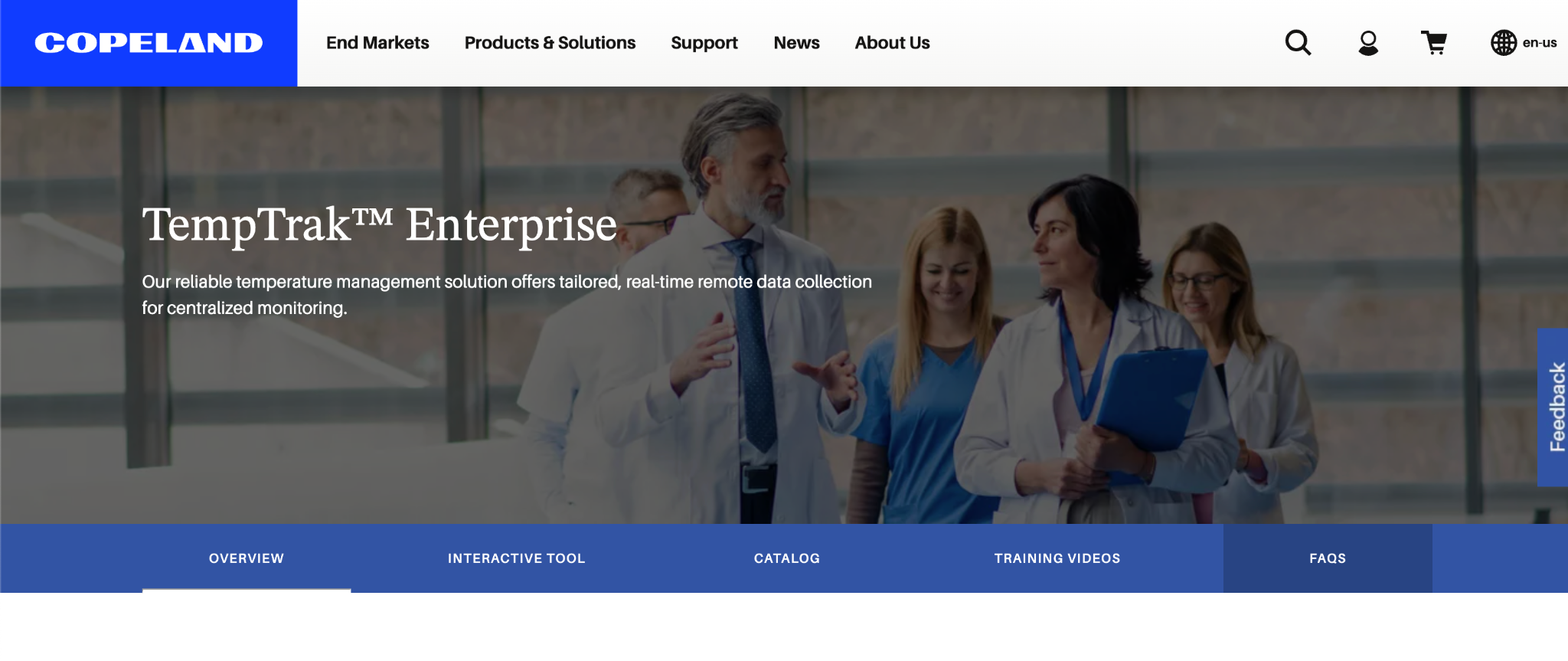
Best for: Hospitals that want a wide range of environmental sensor types from one established vendor.
TempTrak is Copeland’s enterprise environmental monitoring system for healthcare. Copeland says TempTrak is trusted by more than 800 hospitals across North America.
What it covers
Copeland lists TempTrak for hospitals and pharmacies, as well as laboratories and clinics. Its published sensor range covers the following.
- Temperature down to -200 °C
- Relative humidity and CO2
- Air pressure and air velocity
- Oxygen depletion and particle count
- Leak detection and power indication
- Contact sensors
Benefits for healthcare facilities
TempTrak’s strengths sit in sensor breadth and in the services around the hardware.
- Alerts follow escalation workflows. Minor deviations get lower-priority notices, while critical excursions alert on-call staff.
- Monitoring reports capture excursions and corrective actions, which creates an audit trail.
- Copeland offers ISO-compliant onsite calibration. Its deployment documentation includes validation protocols.
- Copeland trains staff at startup, and its subscription support agreements include ongoing training.
Before you buy
Two points shape how TempTrak fits into a hospital.
- Transmitters run on 900 MHz radio or Wi-Fi, per Copeland. A Wi-Fi setup brings the hospital network into scope, so confirm which one a site would use.
- Product scope is environmental. Life safety testing sits outside its published scope.
3. Securitas Healthcare
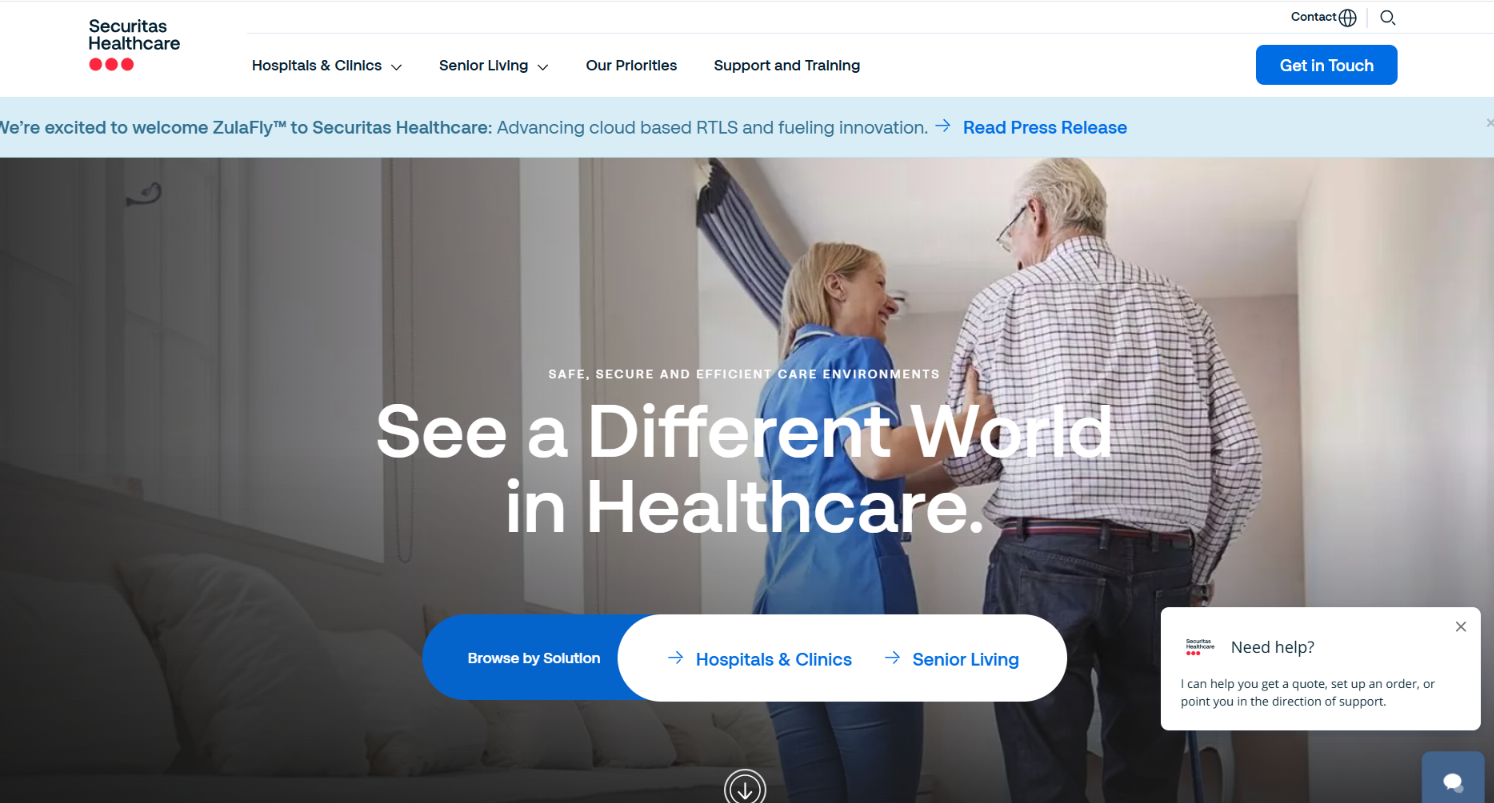
Best for: Hospitals already running Securitas Healthcare RTLS that want environmental monitoring on the same platform.
Securitas Healthcare offers environmental monitoring as one part of a wider RTLS and protection suite. Its sensor tags report into the MobileView visibility and analytics platform, per Securitas Healthcare.
What it covers
Securitas Healthcare monitors cold storage and room conditions through wireless tags.
- Temperature and humidity in cold storage units or on walls
- Vaccines for Children (VFC) and voltage monitoring
- Door and window status through contact tags
- Connections to smoke and flood detectors, plus motion sensors
Benefits for healthcare facilities
Securitas Healthcare builds on an RTLS platform that many hospitals already use.
- Tags get annual NIST-traceable calibration through an ISO/IEC 17025 accredited program.
- When an alert fires, staff can log the corrective action in the same application.
Before you buy
The network model is the main point to plan around.
- Securitas Healthcare says the system runs over the facility's Wi-Fi network, so IT involvement is part of deployment planning.
- Environmental monitoring is one module in a broader RTLS suite. Life safety testing sits outside its published scope.
4. CenTrak
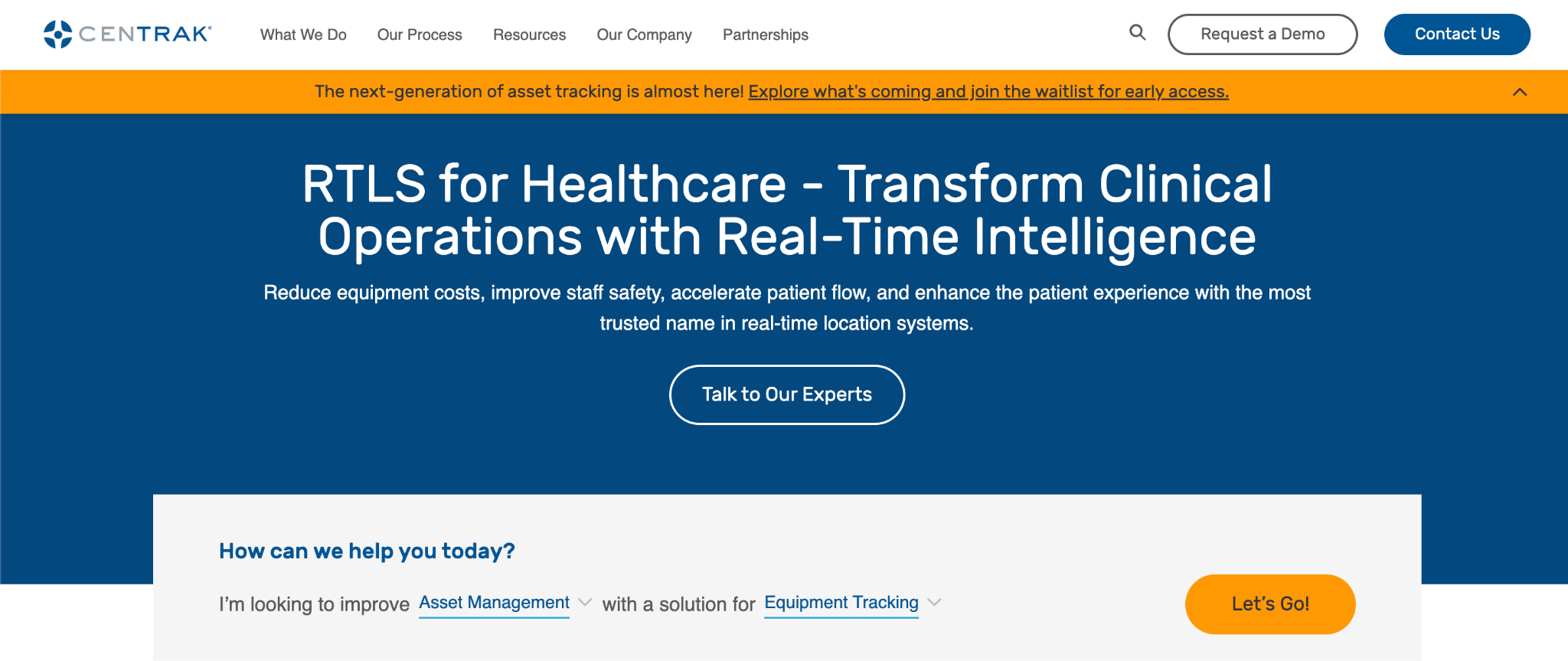
Best for: Hospitals investing in a real-time location system (RTLS) for asset tracking that want environmental monitoring from the same vendor.
CenTrak is a hospital RTLS vendor. Its CenTrak Environment product can run as an add-on to CenTrak RTLS or as a standalone system. As a hospital environmental monitoring system, its sensor list reaches into specialized storage, such as liquid nitrogen fill levels.
What it covers
CenTrak Environment measures a wide set of conditions, per CenTrak.
- Temperature, including ultra-low temperature
- Ambient temperature and humidity
- Differential air pressure and door-ajar status
- Oxygen levels and liquid nitrogen fill levels
CenTrak names use cases including pharmacy and vaccine storage. Blood banks and pressurized rooms are on its list as well.
Benefits for healthcare facilities
CenTrak’s strengths lie in documentation and in sharing one vendor with RTLS.
- Offers NIST-traceable sensors.
- Alarms follow customizable escalation chains, and the corrective action for each alarm is logged.
- CenTrak’s healthcare brochure says its software adheres to Food and Drug Administration (FDA) 21 CFR Part 11 guidance for electronic records.
- CenTrak cites $970,000 in annual labor savings at Atrium Health Wake Forest from automating temperature monitoring.
Before you buy
The network setup is the main point to settle early.
- Sensors run on CenTrak’s ultra-high frequency (UHF) 900 MHz network and/or hospital Wi-Fi, per CenTrak. Confirm which one a deployment would use, since Wi-Fi brings IT into scope.
- Scope is environmental monitoring and RTLS. Life safety testing sits outside it.
5. Sonicu
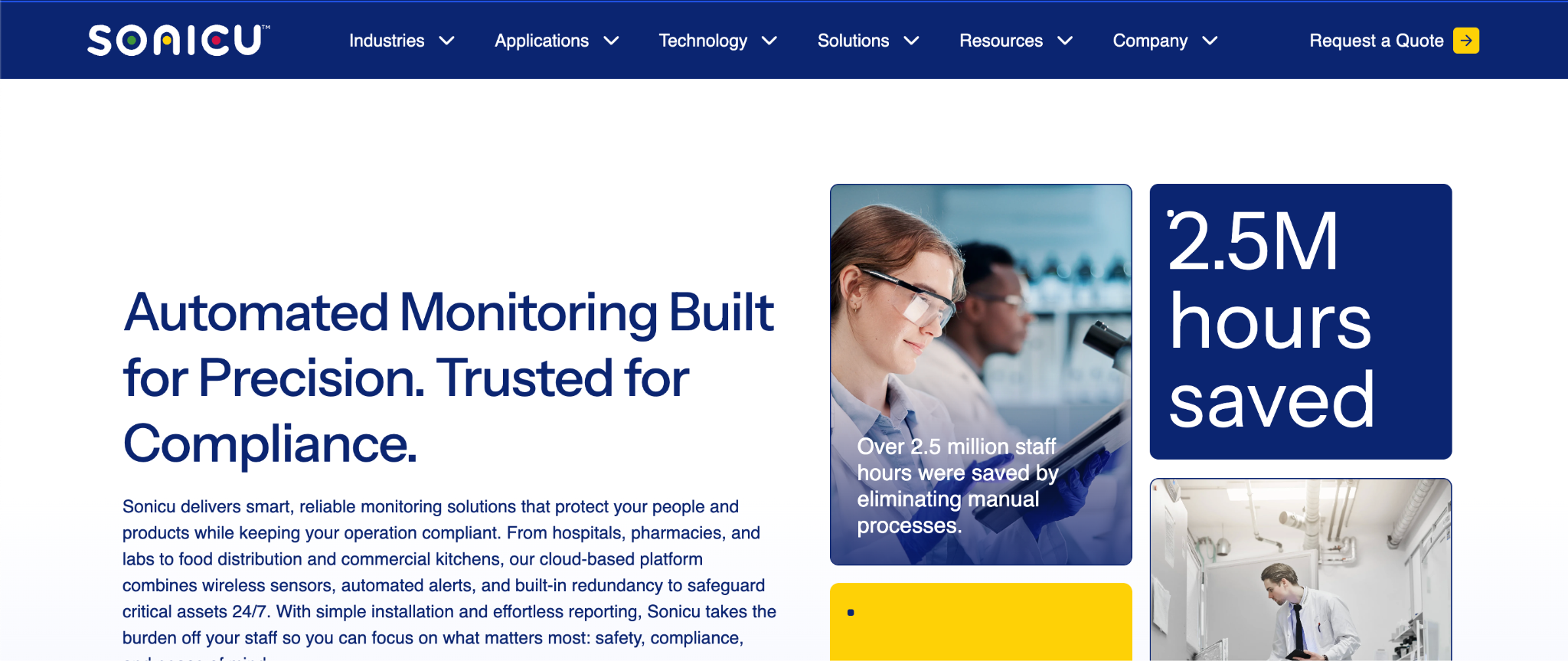
Best for: Hospitals that need isolation rooms and OR pressure monitoring with a fast install.
Sonicu offers automated temperature and environmental monitoring. For room pressure monitoring in a hospital, it has dedicated differential pressure and clean room options.
What it covers
Sonicu monitors cold storage and room conditions, with add-on facility sensors.
- Refrigerator and freezer temperatures
- Ambient temperature and humidity
- Differential pressure, with SoniShield Duo and SoniShield View meters
- Water leaks and door open or closed status
Benefits for healthcare facilities
Sonicu’s customer stories show what pressure monitoring can catch in practice.
- At UHS South Texas, testing the fire alarm system affected the air handler, which caused pressure problems in the ORs.
- “There was no airflow and no exhaust, and we could see it right away,” says Jonathan Larraga, CHFM.
- A Nomi Health testimonial on Sonicu’s site says installing a probe takes two minutes.
Before you buy
Network choice and scope are the two points to confirm.
- Sonicu lists cellular and Wi-Fi data options. Ethernet and cellular failover are listed too. Confirm which one a site would use, since Wi-Fi and Ethernet bring IT into scope.
- Product scope is environmental. Life safety testing sits outside its published scope.
6. SensoScientific
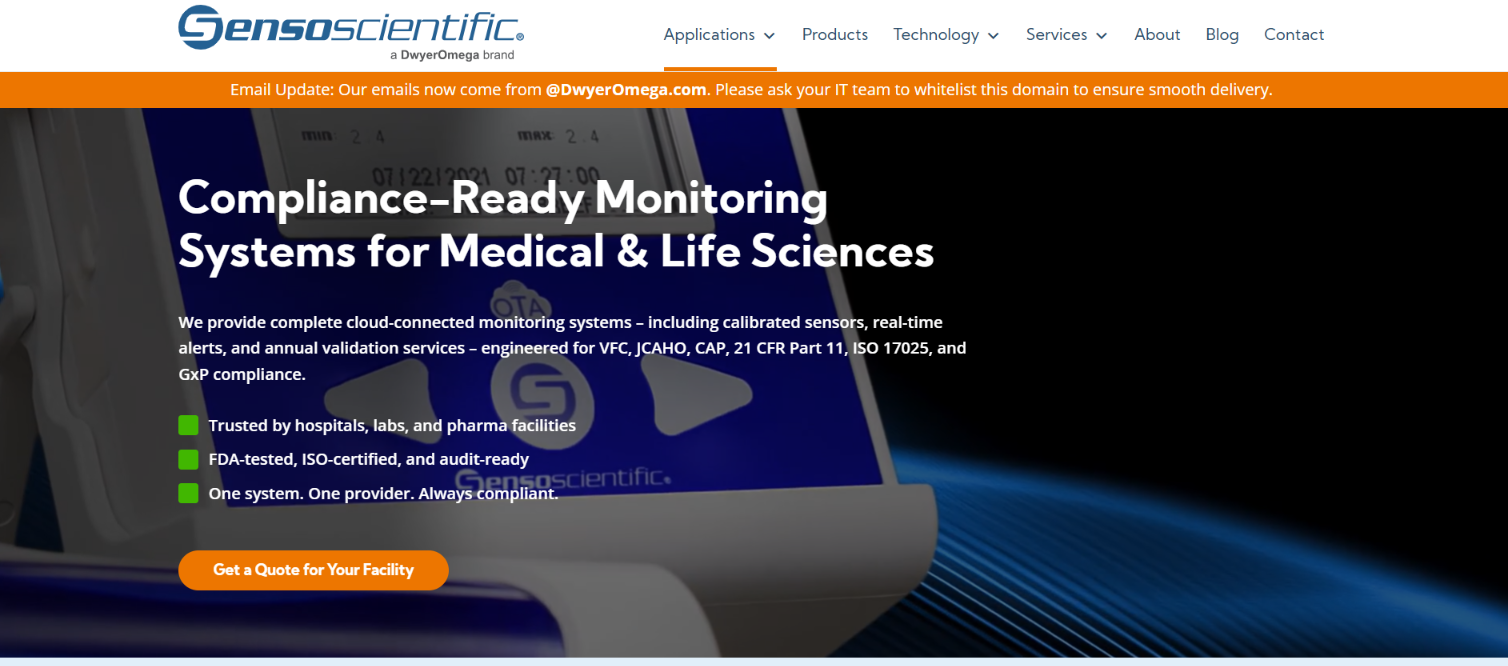
Best for: HealthTrust or Vizient members standardizing temperature monitoring across pharmacies and vaccine storage.
Temperature monitoring is SensoScientific's core product, and hospitals are among its main settings. It also holds awarded supplier status with several group purchasing organizations (GPOs), per SensoScientific.
What it covers
Temperature is the main parameter, and SensoScientific lists several others.
- Differential pressure and humidity
- Water leaks and light
- CO2 and oxygen, plus dry contact
- Settings including hospitals and blood banks, plus pharmacies and labs
- VFC among the standards its systems are built for
Benefits for healthcare facilities
SensoScientific's strengths lie in purchasing access and calibration.
- SensoScientific says HealthTrust selected it as its exclusive temperature monitoring provider after a vendor selection process.
- Provides ISO/IEC 17025 and NIST-traceable calibration.
- Data sits in a validated cloud platform on Microsoft Azure, which SensoScientific describes as FDA 21 CFR Part 11 validated.
Before you buy
Network choice and scope are the points to confirm.
- SensoScientific lists Wi-Fi monitoring as an option. It also lists cellular connectivity for facilities with network limits. Confirm which one a hospital deployment would use.
- Scope is environmental. Life safety testing sits outside its published scope.
7. Signify FirstLink
Best for: New construction or renovation projects that are specifying emergency lighting fixtures anyway.
FirstLink is a connected emergency lighting testing system from Signify’s Bodine brand. Testing happens inside the fixture itself, so no technician has to press a test button.
What it covers
FirstLink handles emergency lighting from the fixture up to the app.
- Emergency lighting drivers and exit signs, plus unit equipment
- A pre-programmed 30-second self-test once a month, per Signify
- A 90-minute self-test once a year
- Results in the FirstLink smartphone app
Benefits for healthcare facilities
FirstLink keeps testing simple and puts it under one manufacturer.
- FirstLink units form a wireless mesh network, so devices talk to one another across a building.
- Phones connect to the nearest unit over Bluetooth Low Energy. The stand-alone system needs no gateway or master controller, per Signify.
- FirstLink Remote Services adds one gateway per group, with a paid service contract. Test results then reach the FirstLink Cloud automatically.
- Test data is stored in the FirstLink Cloud, and the app exports reports as CSV files.
- Among the life safety tools here, FirstLink puts testing and the fixture under one manufacturer.
Before you buy
Fixture compatibility is the main point to plan around.
- FirstLink’s communication node works only with FirstLink’s own products, per Signify. Existing emergency lighting may need to be replaced with compatible units.
- Scope is emergency lighting. Environmental monitoring sits outside its published scope.
8. ABB Emergi-Lite NexusPro
Best for: Facilities standardizing on Emergi-Lite fixtures that want app-based monitoring of emergency lighting.
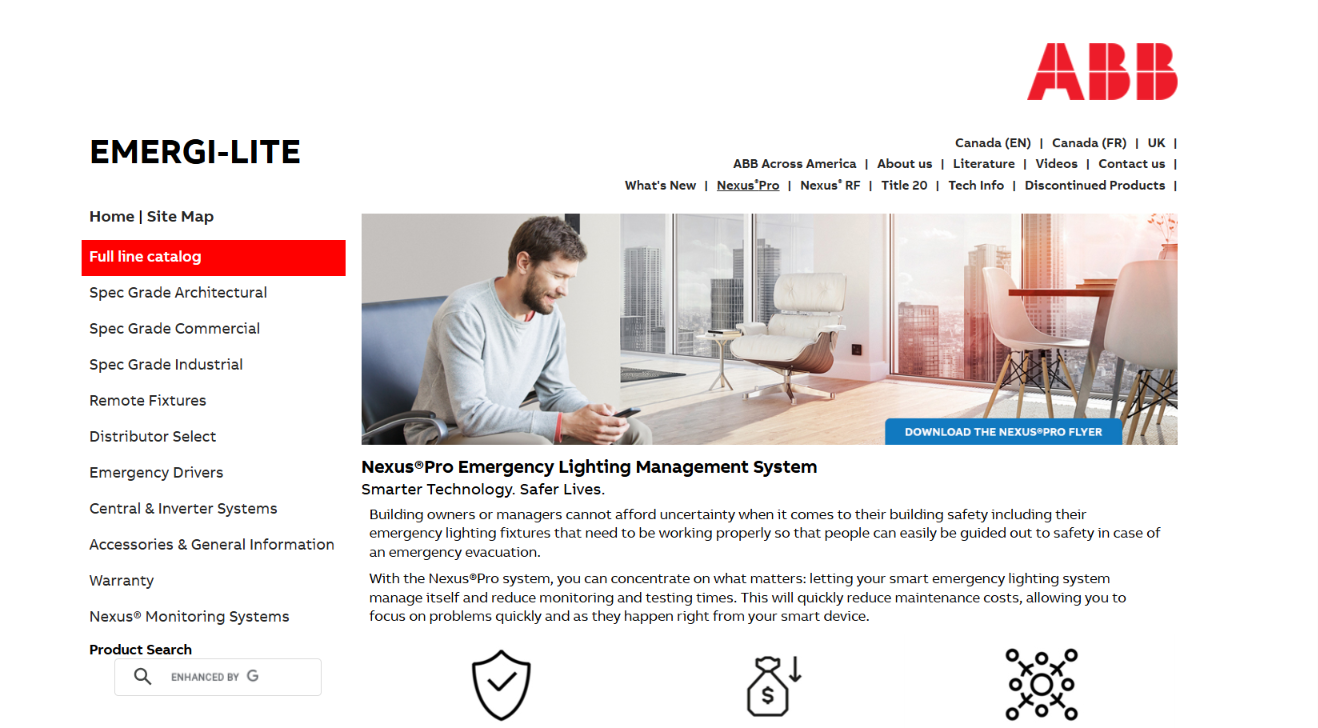
NexusPro is a wireless emergency lighting management system from ABB's Emergi-Lite line. It runs through a phone app.
What it covers
NexusPro connects emergency lighting units into one cloud-based system, per ABB.
- Emergency lighting units linked over a wireless Bluetooth mesh
- An ABB gateway that supports up to 200 units, with no limit on gateways per system
- Testing schedules and malfunction data stored in the ABB Ability Cloud Platform
- Setup and monitoring through the NexusPro phone app
Benefits for healthcare facilities
NexusPro takes much of the walk-around out of emergency lighting checks.
- ABB says teams can test fixtures from a smart device or laptop. That works without visually checking each fixture or cutting the power supply.
- ABB lists healthcare among NexusPro's applications.
- The app is free, with no subscription or license fees, per ABB.
Before you buy
Compatibility and network setup are the points to plan around.
- All units need to be NexusPro compatible. ABB says the module can't be added to other equipment, so new units must be bought.
- The gateway connects to the facility's Wi-Fi or Ethernet, which brings the hospital network into scope.
- Scope is emergency lighting. Environmental monitoring sits outside its published scope.
9. InspectNTrack
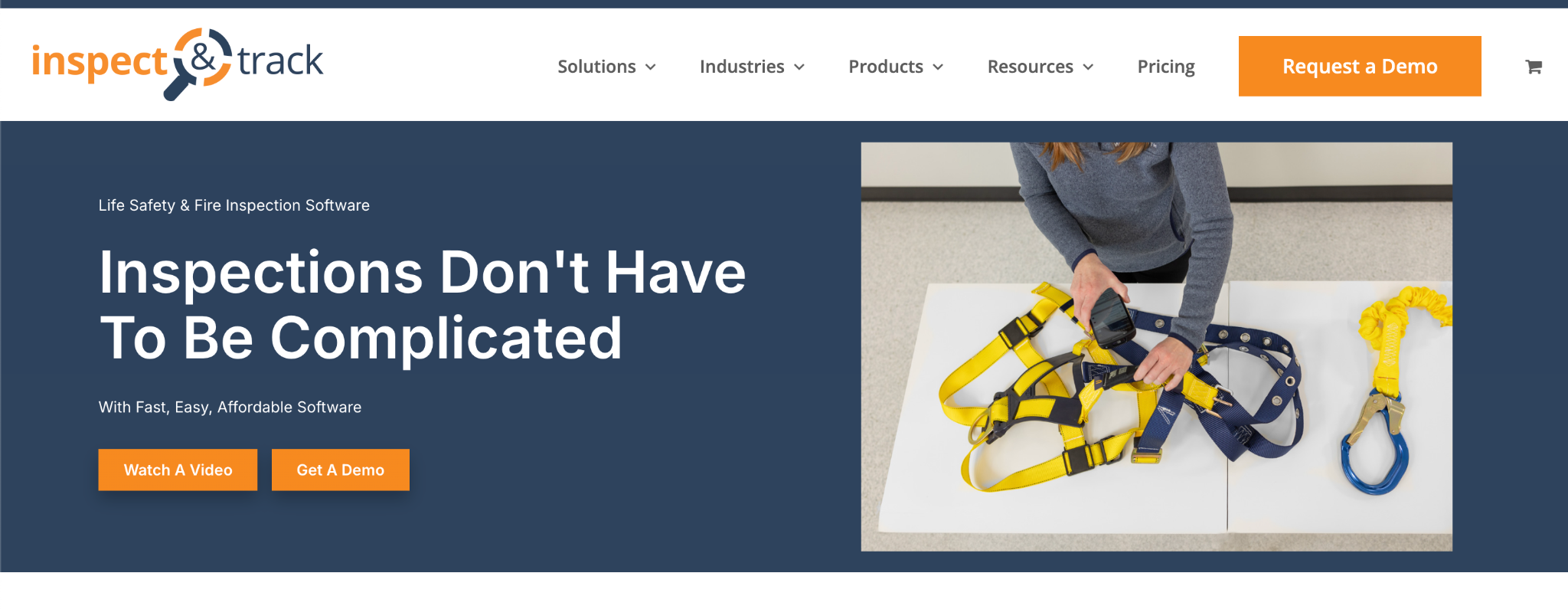
Best for: Teams that plan to keep in-person inspection rounds and want consistent digital records with extinguisher inventory control.
InspectNTrack digitizes the inspection round rather than automating it. Its mobile app replaces paper inspection forms with barcode scanning, per InspectNTrack.
What it covers
InspectNTrack schedules and tracks inspections on many types of equipment.
- Fire and life safety equipment
- Labs and property management
- Barcode scanning at each device, with inspections completed in a mobile app
- NFPA compliance tracking, per InspectNTrack’s app listing
Benefits for healthcare facilities
As fire extinguisher inspection software, InspectNTrack handles inventory in detail.
- A technician can remove a discharged extinguisher and put a spare into service with a barcode scan.
- Teams can customize equipment types and create their own inspection questions.
- Coverage reaches well beyond extinguishers.
Before you buy
The method itself is the point to weigh.
- The record becomes digital, and the walk stays. A technician still visits each device on schedule.
- For a side-by-side look at the two methods, see our comparison of barcode scanning and sensor monitoring.
Which Tool Fits Your Facility Portfolio?
The right tool depends on what you manage today and what you plan to keep. Four common profiles cover most facilities teams.
- A multi-site health system with both categories in scope. Hexmodal covers emergency lighting and environmental monitoring on one platform. Its network sits outside hospital IT. It suits systems with off-site clinics and MOBs that need one view across sites. It also suits pharmacies and labs, where both categories share the same space.
- A hospital with RTLS already deployed. CenTrak or Securitas Healthcare can add environmental monitoring to the platform staff already use.
- A single building replacing emergency fixtures during a renovation. Signify FirstLink or ABB NexusPro build testing into the new fixtures.
- A team keeping manual rounds. InspectNTrack turns those rounds into consistent digital records.
Whichever profile fits, the demo call is where claims get tested.
Making the Final Call on Healthcare Compliance Companies
The right choice comes down to two numbers. The first is how many compliance categories your team manages. The second is how many vendors you want managing them.
If you manage one category in one building, a focused tool from this list may be all you need. If you manage both categories across many sites, every extra vendor repeats in every building. Hexmodal covers both categories on its own network, so devices stay off hospital Wi-Fi and Ethernet.
Talk with Hexmodal about compliance automation for your facilities.
Frequently Asked Questions
1. What does healthcare facility compliance software do?
It helps facilities teams prove that building systems meet code. The software tests life safety equipment such as emergency lights, or monitors conditions such as refrigerator temperature and room pressure. It then stores time-stamped records that surveyors from CMS, the Joint Commission or DNV can review.
2. Can one platform cover emergency lighting and pharmacy refrigerators?
Yes, where the vendor covers both categories. Most tools focus on one category, either life safety testing or environmental monitoring. The coverage table in this article shows which tools cover which category. Check each vendor's published scope before you build a shortlist.
3. Do connected compliance devices need the hospital Wi-Fi network?
It depends on the vendor. Some devices run on hospital Wi-Fi or Ethernet, which usually brings IT review into the project. Others run on their own radio and cellular network. Ask each vendor which network its devices use before you set a deployment timeline.
4. Can automated testing replace monthly manual emergency lighting tests?
Self-testing devices can run the required tests on schedule. Hexmodal devices run the NFPA 101 monthly 30-second test and annual 90-minute test automatically. Confirm with your AHJ how it wants test records presented, since record format can vary by jurisdiction.
5. How do facility compliance tools support a Joint Commission survey?
They give surveyors a complete record without a binder hunt. Look for time-stamped test and sensor records. Corrective actions should be tied to the event that triggered them. Reports should come in the format your AHJ expects and be searchable across every building.
6. What should a facilities manager ask for a vendor demo?
Start by asking which compliance categories the platform covers. Next, ask whether its devices need hospital Wi-Fi or an IT review. Then ask how alerts reach the right person after hours. Finally, ask the vendor to show an AHJ-formatted report and explain what the subscription includes.
Chris Hariz
Founder
Summarize this article with:



Automate your monthly life safety testing
Wireless devices, automatic logs, and AHJ ready reports. No IT involvement, no upfront hardware cost.
3,800+
facilities
150,000+
devices


Stop chasing signatures on a clipboard
See the devices running in a facility like yours, in a 20 minute
walkthrough.

Schedule Your Demo
Demo request received
Someone from the team will be in touch shortly to schedule your demo.
Something Went Wrong
Your request couldn’t be submitted. Please try again or refresh the page.
General Inquiry
Thanks for getting in touch.
We’ve received your message and will get back to you shortly.
Something Went Wrong
Your request couldn’t be submitted. Please try again or refresh the page.