.svg)
DNV surveys hospitals annually under NIAHO. See what EOC and Life Safety surveyors check by cadence, and how to keep evidence audit-ready throughout the year.
Article
How to Prepare for a DNV Hospital Survey: A Life Safety & Environment of Care Readiness Checklist

Chris Hariz
Healthcare
September 24, 2026



DNV surveys hospitals annually under its NIAHO program, inside a three-year accreditation cycle, so Environment of Care and Life Safety readiness must be a daily operating state rather than a pre-survey scramble. DNV also layers ISO 9001 process expectations on top of standard EOC and Life Safety criteria, requiring evidence to trace from policy to practice to log to corrective action to closure. This guide covers what a DNV surveyor checks, organized by cadence, and where continuous monitoring can close documentation gaps.
The DNV Readiness Problem: Why Annual Surveys Change the Prep Model
Most facility teams think about survey prep the way they'd think about a triennial inspection: pull the binder, walk the building, fix what's obviously broken, wait for the next cycle. DNV's NIAHO model doesn't work that way. Because the survey happens every year inside a three-year accreditation cycle, there is no long gap in which a facility can quietly let logs lapse and catch up later.
DNV describes its annual surveys as promoting "safety, improvement, and compliance" under its International Accreditation Standard (DIAS). That framing matters operationally. A single clean day of readings, one well-organized binder pulled together the week before a visit, does not demonstrate the kind of sustained, process-driven compliance DNV's model is built to evaluate.
The ISO 9001 layer compounds this. Hospitals accredited under NIAHO reach ISO 9001 certification at the end of their fourth annual survey, which means the surveyor isn't just checking whether a fixture works today.
They're looking for a documented, repeatable process: a policy that exists, a task performed on schedule, a log that proves it happened, a corrective action when something fails, and a closed loop showing the fix was verified.
For a Director of EOC/Life Safety, that reframes the whole job. "Preparing for DNV" isn't really preparation in the traditional sense. It's the ability to produce, on any random day of the year, a clean evidence trail across every Life Safety and EOC category the surveyor is likely to sample. That's a materially different operating posture than reacting to a known date on the calendar.
What a DNV Surveyor Actually Checks
DNV's own Survey Documents Request List, along with the confirmed Life Safety codes tied to specific equipment categories, gives a reasonably clear picture of what gets checked and how often. The items below are organized by how frequently the underlying task recurs, because that cadence is what actually drives whether your evidence trail holds up.
Always-on / baseline posture
- A leadership roster, physical environment management plan, floor plans, and current life safety drawings that can be produced on short notice, not only when a survey date is confirmed.
- Committee minutes and other governance records that show EOC issues are being reviewed and acted on as an ongoing process, not just discussed once a year.
- A traceable chain from policy to practice to log to corrective action to closure, since DNV's ISO 9001-influenced process expects more than a clean-looking binder; it expects the underlying data to back it up.
Monthly
- Every emergency light and exit sign in the building completes its NFPA 101 Section 7.9.3 monthly 30-second function test, with the pass/fail result logged and any failure routed into a tracked corrective action before the next monthly cycle.
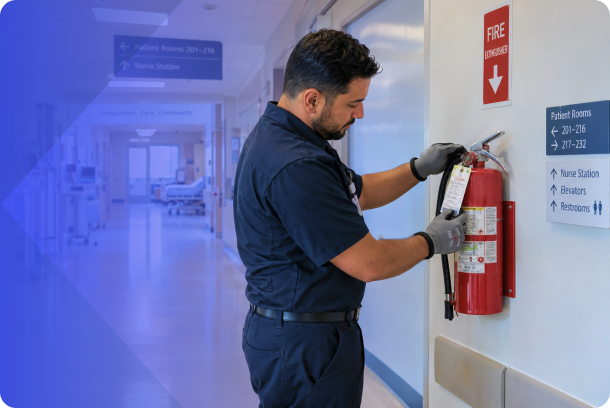
- Every portable fire extinguisher passes its NFPA 10 monthly inspection: correct pressure, correct weight, unit physically present, tamper seal intact, and access to the unit unobstructed, with a timestamped record on file for each device.
Annual
- Every emergency light and exit sign completes its NFPA 101 Section 7.9.3 annual 90-minute discharge test, documented in a format acceptable to the authority having jurisdiction (AHJ).
- Fire extinguishers receive their NFPA 10 annual maintenance inspection performed by a qualified technician, which is a separate obligation from the monthly walk-down and cannot be satisfied by it.
- Extinguishers on the applicable service cycle also need their 6-year internal examination and periodic hydrostatic testing; neither the monthly check nor an automated monitor replaces these.
- The hospital completes its NIAHO annual survey within the broader three-year accreditation cycle, and if the facility is in year four, this is the survey tied to ISO 9001 certification.
Documentation You Need to Produce on Demand
DNV publishes an official Survey Documents Request List, and the practical reality for an EOC/Life Safety director is that everything on it needs to be retrievable immediately, not reconstructed once a surveyor is standing in front of you.
That list includes items like the leadership roster, the physical environment management plan, current floor plans and life safety drawings, and relevant committee minutes. None of these are things you can produce well under pressure if they aren't already maintained as living documents throughout the year.
The same logic applies to every corrective action tied to a failed monthly test, an out-of-range environmental reading, or a flagged deficiency. Each one should clearly show what was found, who was notified, and when it was resolved, because that's the specific evidence chain DNV's process orientation is built to evaluate.
If a survey does produce a finding that requires a Corrective Action Plan (CAP), some hospital-posted DNV materials reference a 10-calendar-day submission window from receipt of the final survey report. Treat that figure as commonly cited rather than a guaranteed universal deadline, and confirm the current CAP timeline directly with DNV before relying on it.
Reports for each equipment and environmental category should be organized so they can be pulled instantly against a specific EOC or Life Safety domain. A binder assembled reactively, after a document request has already been made, is a sign of a program that only performs well right before a survey.
Where Manual Review Still Applies
No monitoring technology, Hexmodal's or anyone else's, covers the full scope of a DNV EOC/Life Safety survey. Several major domains are evaluated entirely through EOC rounds, physical walkthroughs, and staff interviews, and they stay manual no matter how much of the equipment-testing side gets automated.
That includes life safety drawings and their accuracy against the current building layout, corridor and egress housekeeping (keeping paths of travel clear), and hazardous materials storage and labeling. It also includes medical gas cylinder security, ligature-risk mitigation programs, and whether staff can demonstrate readiness for emergency codes when a surveyor asks them directly.
Even within the categories that do have automated monitoring, the physical fix is still a human task. An automated system can detect and log that an emergency light failed its test, that a room drifted out of its pressure range, or that a leak sensor triggered, but a technician still has to replace the fixture, repair the HVAC issue, or physically stop the leak. Detection and documentation are not the same as correction.
The same separation applies to fire extinguisher servicing. A monthly automated inspection confirms pressure, weight, presence, tamper status, and clear access, but it does not perform the NFPA 10 annual maintenance inspection by a qualified technician, the 6-year internal examination, or hydrostatic testing. Those remain scheduled, human-performed obligations on their own cycle regardless of what the monthly check shows.
How Hexmodal Supports This
Hexmodal's device categories are built around the specific test cadences named in the checklist above, and they close a real evidence gap: proving, on any given day, that a required test happened, what the result was, and what corrective action followed.
For emergency lighting and exit signs, Hexmodal automates the NFPA 101 Section 7.9.3 monthly 30-second function test and the annual 90-minute discharge test, with battery and lamp health monitoring, pass/fail logging per device, failure alerts, and AHJ-formatted reports pulled from an interactive floorplan.
What it does not do is physically repair or replace a failed fixture, or cover any life safety element outside emergency lighting, such as fire doors or sprinkler testing.
For portable fire extinguishers, Hexmodal automates the NFPA 10 monthly inspection: pressure, weight, presence, tamper status, and obstruction, each with a timestamped record and a gauge photo, plus automatic corrective-action logging when something fails. It does not perform the annual maintenance inspection, the 6-year internal examination, or hydrostatic testing; those stay on the manual, technician-driven schedule described above.
For critical spaces like isolation rooms, ORs, and pharmacy, Hexmodal's room environment monitors track pressure differential, temperature, and humidity continuously, logging excursions with start time, duration, notification, and corrective action in a CMS/AHJ-exportable format. The system documents when a room drifted out of range and how it was closed out; it does not perform the HVAC repair or door fix that caused the excursion.
For cold storage holding vaccines, blood products, reagents, or samples, continuous temperature logging with drift alerts and NIST-traceable calibration tracking replaces the handwritten daily log that typically gets reconstructed right before a survey. Leak detection in mechanical rooms, server rooms, and pharmacy or lab storage adds a similar continuous record for water-related incidents, supporting internal EOC risk documentation even though it isn't tied to a specific NFPA or DNV citation.
Across all of these categories, a single dashboard and exportable PDF/CSV reporting let a director pull organized evidence against a specific domain instead of assembling it reactively once a document request arrives.
Schedule a Demo
Schedule a demo to see how continuous monitoring can support your EOC and Life Safety readiness program.
FAQ
How often does DNV actually survey a hospital, and is the visit scheduled or unannounced?
DNV surveys hospitals annually under its NIAHO program, inside a three-year accreditation cycle, per DNV's own psychiatric hospital accreditation page. Whether visits are announced or unannounced is not confirmed in the official source material reviewed here, so confirm this directly with DNV.
What is the real difference between preparing for a DNV NIAHO survey and preparing for a Joint Commission survey on the Life Safety and EOC side?
The clearest confirmed difference is DNV's ISO 9001 layer: hospitals accredited under NIAHO reach ISO 9001 certification at the end of their fourth annual survey. This pushes DNV's process expectations toward continuous, traceable evidence rather than a single point-in-time check.
What documents will a DNV surveyor expect us to hand over on the spot during an EOC or Life Safety walkthrough?
DNV publishes an official Survey Documents Request List, which typically includes items like a leadership roster, the physical environment management plan, current floor plans, life safety drawings, and committee minutes. These should be maintained year-round so they can be produced immediately, not assembled after the request.
Does keeping our DNV accreditation also mean we have to maintain ISO 9001 certification?
Hospitals accredited under NIAHO reach ISO 9001 certification at the end of their fourth annual survey, tying the two together within DNV's model. Confirm the exact maintenance requirements for that certification directly with DNV, since specifics beyond this point are not detailed in the source material reviewed here.
How long do we have to submit a corrective action plan after a survey finding, and who confirms that deadline?
Some hospital-posted DNV materials reference a 10-calendar-day window from receipt of the final survey report to submit a Corrective Action Plan. Treat this as commonly cited rather than guaranteed, and confirm the current deadline directly with DNV against the active NIAHO manual.
If our emergency lighting and fire extinguisher testing is automated, does that cover everything DNV checks in the physical environment, or is there still work our team has to do by hand?
Hexmodal's automated monitoring covers specific recurring tests, like the NFPA 101 monthly and annual emergency lighting checks and the NFPA 10 monthly extinguisher inspection, but it does not cover annual extinguisher maintenance, life safety drawings, egress housekeeping, hazardous materials storage, medical gas security, or staff interviews. Those domains stay manual regardless of what monitoring technology is in place.
Author:
Chris Hariz
Category:
Healthcare
Date:
September 24, 2026
Keep reading
Related Articles

Schedule Your Demo
Demo request received
Someone from the team will be in touch shortly to schedule your demo.
Something Went Wrong
Your request couldn’t be submitted. Please try again or refresh the page.