



Compliance
How to Prepare for a Joint Commission Survey: An Environment of Care and Life Safety

October 30, 2026

On this page

Key Takeaways
- Joint Commission survey pairs a facilities document review with a building tour, and the SAFER matrix scores each finding.
- Joint Commission's Physical Environment standards combine the former Environment of Care and Life Safety chapters.
- Joint Commission no longer requires hospitals to keep written Environment of Care management plans. The work those plans described is still in scope.
- The Survey Process Guide gives hospitals and surveyors one resource for standards, regulatory requirements, and survey activities.
- Hexmodal devices test emergency lights and monitor room pressure and storage temperatures automatically, filing each result as a time-stamped record.
A Joint Commission survey can begin with a notice in Joint Commission Connect and a survey team at the front desk soon afterward. One question then shapes the physical environment portion of the visit. Can your team produce the requested testing records that morning for every building in scope?
Teams that answer yes may have completed the same work as teams that hesitate. The difference often lies in where the records live and who can retrieve them. This guide covers what surveyors review, which evidence supports each check, the questions staff may face, and the program that keeps readiness active between surveys.
** The guidance below reflects Hexmodal’s observations from working with hospital facilities teams, along with publicly available Joint Commission materials. It is intended for general informational purposes only and does not guarantee survey outcomes or constitute legal, regulatory, or accreditation advice. Joint Commission requirements, codes, and standards may change, and their application may vary by facility and circumstances. Readers should verify current requirements with The Joint Commission, their Authority Having Jurisdiction (AHJ), and qualified counsel, as applicable. Hexmodal makes no guarantee regarding the accuracy or completeness of this information and assumes no liability for actions taken based on it.
What Does a Joint Commission Survey Cover in the Physical Environment?
On the physical environment side, a Joint Commission survey includes document review and a tour of the facility.
- Document review: Checks whether records show that required work was completed
- Facility tour: Checks whether the actual conditions match what the records describe
1. Physical Environment Standards and Survey Preparation
Joint Commission's Physical Environment standards combine what facilities teams previously knew as the Environment of Care and Life Safety chapters. Emergency management remains in a separate chapter. Also, the Director of Environment of Care may keep the same job title even though the standards now use a different structure.
A Director of Environment of Care or Life Safety Officer often leads the facilities document session. Plant operations and engineering leaders speak for their systems, while a records owner retrieves logs and reports. Fast, accurate retrieval helps the team answer questions without interrupting the rest of the session.
Scope of the session can sometimes extend beyond the main campus. Off-site clinics and medical office buildings may be included, even though those locations often have thinner facilities coverage and inconsistent recordkeeping.
2. Extending Compliance Coverage Across Facilities
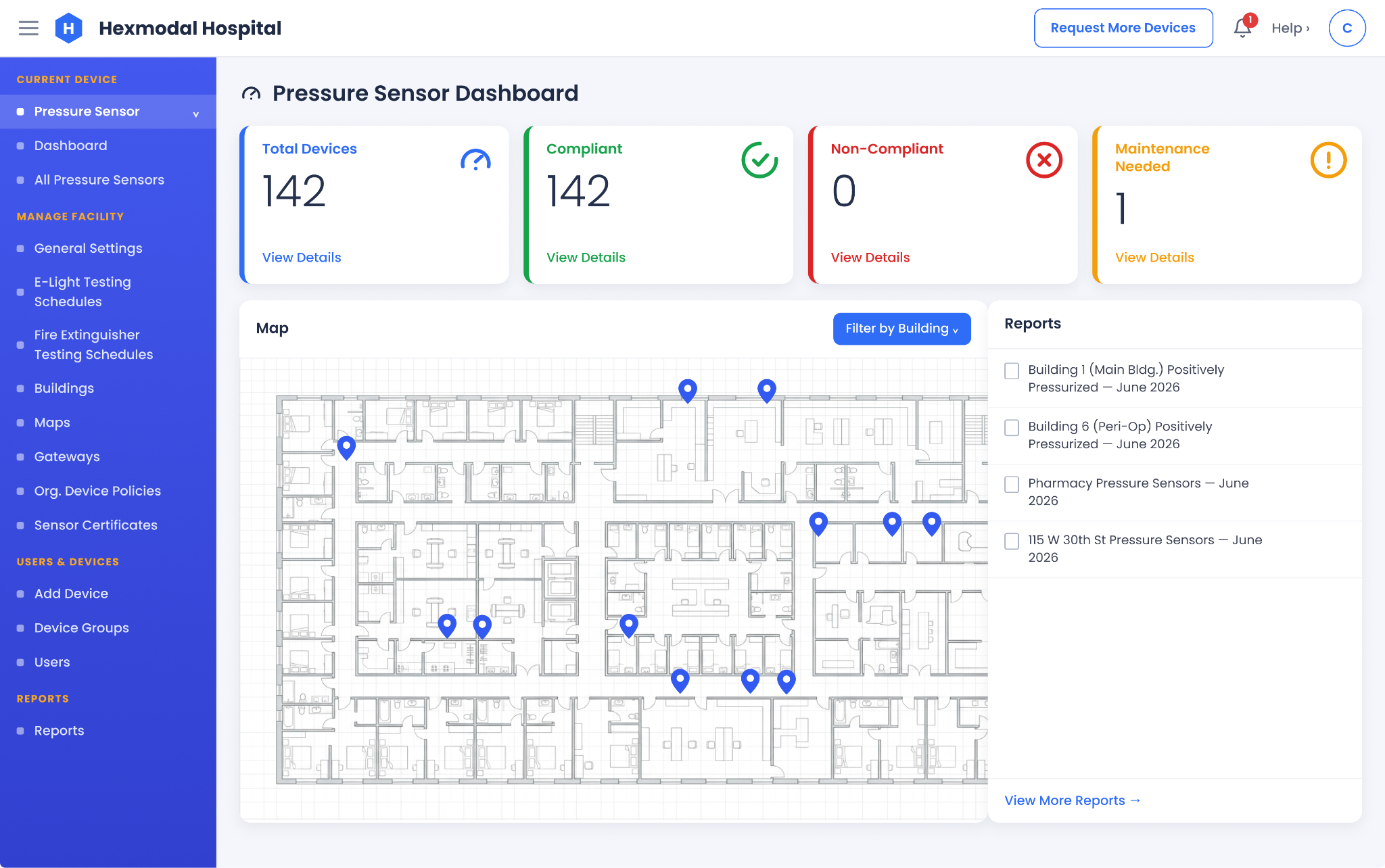
Hexmodal's hospital compliance platform brings device status and test records from multiple buildings into one dashboard, while its off-site facilities program extends that view to clinics and medical office buildings.
Joint Commission accreditation can provide deemed status for Medicare participation. A CMS validation survey is conducted by a state survey agency acting on behalf of CMS and evaluates a deemed hospital against federal Conditions of Participation. Hexmodal's guide to CMS Environment of Care and Life Safety surveys explains what surveyors verify and how facilities can maintain the documentation needed to demonstrate compliance.
To estimate automated testing across a campus and its off-site buildings, check Hexmodal pricing.
Which Guide Do Surveyors Work From?
Hospital and critical access hospital surveyors use Joint Commission's Survey Process Guide. Effective January 1, 2026, the guide replaced the Survey Activity Guide for those two accreditation programs and became a shared resource for surveyors and accredited organizations.
Joint Commission describes the guide as a unified source for standards, corresponding Conditions of Participation, and survey activities. The organization publishes separate guides for hospitals and critical access hospitals, so each facility should use the document for its accreditation program.
Other accreditation programs may follow different materials. A health system that holds several Joint Commission accreditations should confirm the current guide for each program instead of applying the hospital document across the enterprise.
The practical advantage is a clearer preparation path. Facilities leaders can review the session sequence and document expectations before a survey begins. Joint Commission's Survey Process Guide page provides the current program information.
It is best to keep a working copy where base-station staff can open it. Older preparation materials may describe the standards before Accreditation 360 and the 2026 guide changes, so do compare inherited checklists with the current guide and accreditation manual.
What Happens in the First Hour?
The first hour tests identity verification, communication, and record access. Notice of the survey is posted to the hospital’s Joint Commission Connect account by 7:30 a.m., and surveyors typically arrive between 7:45 and 8:00 a.m. Prepare the front desk and house supervisor to begin the response process before the accreditation lead reaches the building.
Verify each surveyor through Joint Commission's approved process before allowing access to clinical areas. Then open a base station with printing, network access, the current Survey Process Guide, and a document index that points staff to each authoritative record.
Assign an escort and record contact for each shift, including nights and weekends. A survey plan may take the team into a mechanical room after the day shift leaves, so the night supervisor needs a reliable route to generator logs and other requested evidence.
Opening-hour checklist:
- Confirm the survey notice through Joint Commission Connect.
- Verify each surveyor's identity through Joint Commission's approved process.
- Open the base station and confirm printing and system access.
- Name the escort and record contact for the current shift.
- Load the Survey Process Guide and document index before the opening conference ends.
Which Documents Does a Surveyor Ask For?
A surveyor may request records for life-safety systems, utilities, equipment, hazardous materials, corrective actions, and construction controls. The exact list depends on the hospital's scope and current Survey Process Guide, so facilities teams should treat the table below as an ownership index rather than a substitute for Joint Commission requirements.
Missing evidence often creates more difficulty than missing work. A test may have occurred while its record remains on a device tag, in a building-specific binder, or with a contractor. Open work orders create another problem when they show when a defect was found but provide no evidence that the repair was completed.
Hexmodal's Digital Binder stores automated tests with timestamps and device locations. Its reporting tools organize results by facility for retrieval at the base station.
A facilities record index for survey preparation. A qualified accreditation or life-safety reviewer should confirm every row against the current Survey Process Guide, accreditation manual, adopted codes, and AHJ direction.
Do You Still Need Environment of Care Management Plans?
Written management plans may sit outside the current hospital requirements under the Physical Environment standards. Some teams still keep them because a plan organizes work by system and names an owner for each responsibility.
The underlying inspections, tests, maintenance, and records remain in scope where required. Retiring a plan should therefore follow a controlled review that moves each obligation into another approved policy, procedure, schedule, or system.
Committee minutes can support the same operational purpose. Minutes that show information moving from departments to leadership, followed by decisions and assigned actions, give a reviewer a readable account of how the program operates.
Reviewer checkpoint: Confirm the current status of management plans and annual program evaluations against the hospital accreditation manual before publication. Do not infer that removing a written-plan requirement removes the underlying work.
How Do Surveyors Test Utilities, Equipment, and Hazardous Materials?
Surveyors evaluate utilities and equipment through records, staff interviews, and direct observation. Emergency-power records should show more than a date, with enough detail to establish what ran, for how long, under what load, and how transfer equipment performed.
Point-in-time utility readings show conditions only when staff record them. Continuous monitoring can provide a fuller history for room pressure, doors, medication storage temperature, and other configured conditions.
Hexmodal's room environment monitoring records pressure, door position, temperature, and humidity. Smart temperature monitoring uses NIST-traceable sensors for refrigerators and freezers, sends alerts for configured excursions, and preserves the trace. The same model can support pharmacies and laboratories across a health system.
Medical equipment records begin when a device enters service. Incoming inspection, scheduled maintenance, failure handling, and repair documentation should follow the organization's approved equipment-management process.
Hazardous-material checks often reach the floor. Staff need a known route to the Safety Data Sheet for a product, and secondary containers need labels that identify their contents according to the applicable policy and regulation.
What Does a Life Safety Specialist Check on the Building Tour?
A life safety specialist compares observed building conditions with the organization's records and the requirements that apply to the facility. Hospitals participating in Medicare should confirm applicable code editions and any state or local amendments with CMS guidance and the AHJ.
- Portable extinguishers: The specialist may review access, location, condition, and inspection records. Electronic monitoring can serve as an inspection method where the adopted NFPA 10 edition permits it and the AHJ approves the method. Hexmodal's NFPA 10 electronic-monitoring guide covers the approval path, while its smart fire extinguisher monitoring tracks configured device conditions and sends alerts.
- Emergency lighting and exit signs: Records should connect each required test with a fixture and carry failures through repair. Hexmodal's smart emergency lights and exit signs run configured recurring tests and log each result against the fixture.
- Fire doors: A door should close and latch as required for its assembly. A specialist may release a held-open door and observe whether it closes without assistance.
- Above-ceiling conditions: Surveyors may inspect penetrations in rated barriers, firestopping, damper access, and work completed above ceilings. Records should identify tested dampers by location and connect deficiencies with corrective action.
- Corridors and egress: Equipment placement must preserve the required means of egress. Policies for equipment in use should match the applicable code and the conditions surveyors observe on the unit.
- Sprinkler clearance: Storage needs to preserve the clearance required below sprinkler deflectors. Shelving and stacked materials should remain outside the protected spray pattern.
- Exit discharge: A compliant route continues through the exit discharge to the required destination. Locked gates, stored materials, or other obstructions can compromise an otherwise compliant path.
- Construction controls: Construction can trigger Interim Life Safety Measures. Keep an assessment for each project, document the temporary condition, and retain any approved waiver or equivalency where the base station can retrieve it.
Five above-ceiling checks for this week:
- Inspect penetrations beside rated barriers on one floor.
- Trace recent cabling work and confirm completed firestopping.
- Confirm that damper access panels remain reachable.
- Inspect the continuity and top-of-wall treatment of rated barriers.
- Check that above-ceiling permits carry the required closeout evidence.
What Will Surveyors Ask Your Staff?
Surveyors may ask front-line staff about fire response, equipment safety, hazardous materials, and the systems around them. Staff should answer in their own words and connect each answer to the room or unit where they work.
1. “What do you do if you find a fire?”
Staff should describe the response taught in the hospital's fire plan and name the first action they would take in that location. A memorized acronym carries less value when the person cannot connect it to the room.
2. “Where are the nearest pull station and extinguisher?”
Staff should point to both from where they stand. Unit orientation works best when new hires physically walk to the equipment instead of reviewing locations only on a map.
3. “What happens here when the alarm sounds elsewhere in the building?”
The answer should reflect the unit's assigned role. Depending on policy and conditions, staff may close doors, protect patients, or stand by for instructions.
4. “Where is the oxygen zone valve, and who may close it?”
Staff should locate the valve and identify the role that hospital policy authorizes to operate it. Training should distinguish finding the valve from making the decision to close it.
5. “How do you know this device is safe to use?”
Staff should identify the hospital's current inspection or status indicator. They should also know the process for removing equipment from service when a device fails or carries an out-of-service tag.
6. “What do you do if a device malfunctions and injures someone?”
The response should follow hospital policy for patient care, incident reporting, evidence preservation, and device removal. Staff should retain relevant accessories when policy requires them for evaluation.
7. “Show me the Safety Data Sheet for this product.”
Staff should retrieve the sheet through the approved route, such as a workstation shortcut or department binder. Practice should use actual products found on the unit.
A staff member can say, “I do not know, and this is how I would find out,” when that statement is accurate. The answer shows a reliable path to the approved information without guessing.
How to answer a surveyor:
How Do You Stay Ready Between Surveys?
Continuous readiness comes from scheduled rounds, targeted tracers, and corrective actions that reach documented closure. A condition found during an internal round can become a survey finding when the organization records it but never verifies the repair.
Focused tracers take one topic through a defined area, such as fire-door latching on one floor. System tracers follow a process across departments, such as the reporting and resolution of a utility failure. Define the scope and expected evidence before each tracer starts.
Mock surveys test the full response sequence. A full-scale exercise begins at the front desk with an outside reviewer acting as the surveyor, while a tabletop session walks the same steps in a conference room.
Previous findings deserve repeated checks. Review the corrective-action evidence submitted for each finding and confirm that the change remains in place.
Automated testing changes what facilities rounds cover. When configured devices perform recurring tests, staff can focus rounds on exceptions and corrective work. Alert routing by building and user group sends an exception to the assigned person.
1 . What Does Readiness Cost to Run?
Hexmodal estimates that manually managing 2,000 devices can consume roughly 2,000 labor hours per year. Treat that figure as a Hexmodal estimate and recalculate it with your own device count, travel time, test duration, and documentation process.
Atlantic Health reports 10,050 hours saved after automating compliance testing with Hexmodal. AdventHealth Fish Memorial and DeLand report a 55% reduction in annual testing costs. Results vary with facility size and device count.
How Does Joint Commission Score What Surveyors Find?
Joint Commission uses the SAFER matrix to communicate the likelihood of harm and scope associated with findings. The Survey Analysis for Evaluating Risk (SAFER) matrix organizes findings by the level of risk they pose and whether they affect an individual, a pattern, or the organization as a whole.
Organizations should use the survey report and current Joint Commission instructions to determine the required response for each finding.
Immediate correction during a survey can protect people and establish control of the condition, but it does not erase the need for a complete organizational response. Produce existing evidence, acknowledge missing evidence accurately, and begin a documented review with an owner and due date.
Disagreements should move through the hospital's accreditation lead and the process Joint Commission provides. A factual response supported by records is more useful than an argument during the document session.
A response framework for SAFER findings. Confirm submission deadlines and accreditation consequences in the current survey report and Joint Commission instructions.
What Happens After the Survey?
After the survey, hospitals generally have 60 days to submit Evidence of Standards Compliance (ESC) for each finding. The applicable deadline and submission requirements depend on the current Joint Commission process and the accreditation decision. Review the hospital’s survey report and follow the instructions provided for each finding before finalizing the response timeline.
A corrective action should identify the completed fix, completion date, accountable owner, and method used to verify that the correction held. Link the repair to the event that triggered it so the record shows both the original condition and its verified resolution.
Hexmodal's CMMS integration can open a work order when a monitored device fails. The technician works in the hospital's existing system, and the resolution can remain connected to the original compliance event.
Keep Your Hospital Ready for the Next Survey
An unannounced survey makes everyday recordkeeping more valuable than last-minute preparation. The evidence requested in the morning reflects work completed across prior months and years, often in several buildings.
Automating recurring tests can reduce the volume of manual checks that grows with device count. Facilities staff can then spend more time on repairs, preventive maintenance, and the corrective work a surveyor observes on the building tour.
Requirements still come from Joint Commission, CMS where applicable, adopted codes, and the authorities that govern each building. Use this guide as an operating framework, then confirm each requirement against the sources that apply to your facility.
Talk with the Hexmodal team about automating the records your next survey may require.
Frequently Asked Questions
1. How Much Notice Does a Hospital Get Before a Joint Commission Survey?
Accreditation surveys are generally unannounced, subject to Joint Commission's current program rules. Keep identity-verification steps, shift escort assignments, and record access ready each day. Confirm exact notice procedures and timing in the current Survey Process Guide.
2. Are Environment of Care Management Plans Still Required?
Current requirements may allow hospitals to retire certain written management plans, while the inspections, tests, maintenance, and records remain in scope. Confirm the exact requirements in the current hospital accreditation manual before changing a plan or annual evaluation process.
3. Can Electronic Records Replace Paper Inspection Tags During a Survey?
Electronic records can support required documentation when the applicable standard and AHJ accept the method. For portable extinguishers, distinguish electronic recordkeeping from electronic monitoring, then confirm the adopted NFPA 10 edition and obtain any required AHJ approval before changing the inspection process.
4. What Happens if a Surveyor Identifies an Immediate Threat to Health or Safety?
Protect patients, staff, and visitors at once, escalate through hospital leadership, and document every action with a time and owner. Follow Joint Commission's current instructions for the accreditation consequences and required response.
5. Do Off-Site Clinics and Medical Office Buildings Get Surveyed?
They may fall within the hospital's survey scope. Standardize records across those locations, name a responsible owner, and make the evidence available from the survey base station.
6. How Does a Joint Commission Survey Differ From a CMS Validation Survey?
Joint Commission accreditation can provide deemed status for Medicare participation. A CMS validation survey, conducted by a state survey agency on behalf of CMS, evaluates a deemed hospital against federal Conditions of Participation. Hexmodal's CMS survey checklist covers the federal preparation side.
Chris Hariz
Founder
Summarize this article with:



Automate your monthly life safety testing
Wireless devices, automatic logs, and AHJ ready reports. No IT involvement, no upfront hardware cost.
3,800+
facilities
150,000+
devices


Stop chasing signatures on a clipboard
See the devices running in a facility like yours, in a 20 minute
walkthrough.



Schedule Your Demo
Demo request received
Someone from the team will be in touch shortly to schedule your demo.
Something Went Wrong
Your request couldn’t be submitted. Please try again or refresh the page.
General Inquiry
Thanks for getting in touch.
We’ve received your message and will get back to you shortly.
Something Went Wrong
Your request couldn’t be submitted. Please try again or refresh the page.