.svg)
How often fire extinguishers need to be inspected under NFPA 10, and the monthly records Joint Commission, DNV and CMS surveyors ask hospital teams to produce.
Article
The Complete NFPA 10 Fire Extinguisher Inspection Schedule for Hospital Facility Teams

Chris Hariz
Product
September 24, 2026


Key takeaways
- NFPA 10 requires a monthly inspection of every portable fire extinguisher in the hospital.
- Annual maintenance and every longer interval belong to a certified technician.
- NFPA 10-2026 is the current standard, and CMS and The Joint Commission survey against the 2010 edition.
- Surveyors expect 12 months of dated and initialled records for each unit.
- NFPA 10 permits electronic monitoring as a method of monthly inspection, subject to Authority Having Jurisdiction (AHJ) approval.
- Physical condition and label legibility remain manual checks under a monitored program.
A Joint Commission surveyor stops at a 10 lb ABC extinguisher in the east stairwell of Building C. They ask to see the last 12 monthly inspection records for that one unit. Could your team pull them up before they reach the next floor? The answer depends on how every check has been recorded since your last survey.
How often do fire extinguishers need to be inspected in an accredited hospital, and what should each inspection leave behind? The answer starts in NFPA 10 and ends in your accreditor's survey tools.
The sections below walk through the schedule and the records surveyors accept. They close with the point at which electronic monitoring can take over the monthly round.
How Often Do Fire Extinguishers Need to Be Inspected?
Under NFPA 10-2026, the current edition, hospital teams inspect every portable fire extinguisher once per calendar month, at intervals of up to 31 days. The 2010 edition that CMS and The Joint Commission cite sets the same monthly cadence.
Annual maintenance follows every 12 months, with longer cycles for internal examination and hydrostatic testing handled by a certified technician.
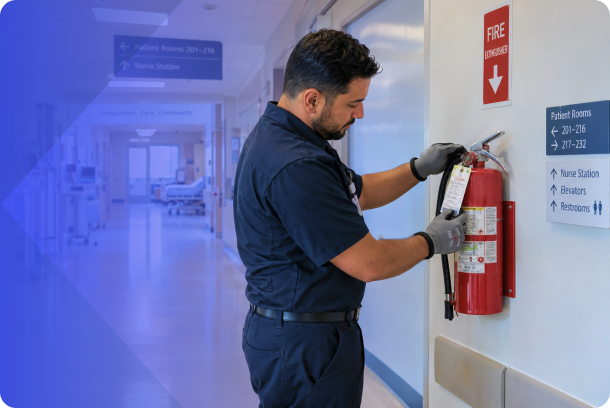
Wondering which of these your own team can handle? The monthly check is the one you can own outright. NFPA 10 Chapter 7 reserves maintenance and recharging for certified personnel, while trained facility staff can carry out the monthly inspection.
Some areas of a hospital may need a closer eye than once a month. NFPA 10 Chapter 7 calls for more frequent inspection when circumstances require it. The annex offers examples such as tampering and exposure to physical damage, although annex text is guidance and your own risk assessment decides how it applies.
This works as a behavioural health unit or a busy emergency department. Both tend to meet that test, and a public lobby with heavy foot traffic can join them. You can set weekly or per-shift checks in these areas and keep the same record format your team already uses for the monthly round.
Which NFPA 10 Edition Your Hospital Is Surveyed Against
Three editions of NFPA 10 can apply to one hospital at the same time, and each plays a different role. The 2026 edition sets the current standard of practice, while the 2010 edition sets what accreditation surveyors cite.
NFPA publishes the 2026 edition as the current version of the standard. State fire codes adopted in future cycles will reference it or a successor. A monthly program built to the 2026 edition stays aligned with where local enforcement is heading, and it needs less rework when CMS updates its adopted code.
You might reasonably ask why a 2010 standard still governs a 2026 survey. CMS incorporated the 2012 edition of NFPA 101, the Life Safety Code, at 42 CFR 482.41, effective July 5, 2016. The Life Safety Code references NFPA 10-2010 for portable extinguishers, so a CMS surveyor works from that edition.
The Joint Commission's review tools cite the same 2010 edition in their elements of performance.
State and local fire marshals add a third layer, since they adopt codes on their own schedules. A state fire code can reference any edition between 2010 and 2026. Your hospital can therefore work to 2026 as current practice while answering to 2010 for accreditation, with the local fire inspection applying a third edition.
Here is the reassuring part. The monthly cadence holds steady across all three editions, so one round satisfies every authority. Section numbers shift between editions, though, so match each citation to the edition the surveyor in front of you enforces.
- How to confirm which edition your Authority Having Jurisdiction (AHJ) has adopted?
Ask your state fire marshal's office which fire code edition is in force and which NFPA 10 edition it references.
- Ask as well whether a new adoption cycle is scheduled, since that would bring in a later edition.
- Check your county and city for local amendments, and keep the answers in writing alongside your Life Safety management plan.
Fire Extinguisher Inspection Requirements for the Monthly Check
Every monthly inspection requires two jobs. Someone trained verifies the unit’s condition, and a record captures that verification with a date and initials. Hospital teams tend to handle the first job well. The second is where a check completed on time can still turn into a survey finding.
1. The seven conditions to verify
NFPA 10-2010, the edition CMS and The Joint Commission enforce, lists the conditions an inspector confirms at each monthly visit in Section 7.2.2. The current 2026 edition carries the same checks forward in Chapter 7. In context of hospital round, your monthly fire extinguisher inspection checklist covers:
- Location: the unit sits in its designated place.
- Access and visibility: the path to the unit is clear and the unit is visible from the approach.
- Pressure gauge: the needle reads within the operable range.
- Pin and tamper seal: the safety pin is in place and the tamper seal is intact.
- Fullness: weighing or hefting confirms the unit is full.
- Physical condition: the cylinder, hose and nozzle are free of damage, corrosion and leakage.
- Instructions and label: the operating instructions are legible and face outward.
For wheeled extinguishers in a loading dock or central plant, include extra checks for tyres, wheels and hose. Give them their own line on the form so they stay visible in the record.
2. The records a surveyor accepts
NFPA 10 lets you choose how you record the monthly check. A tag or label attached to the unit is acceptable, and so is a checklist kept on file or an electronic record. One format meets the requirement. Running a tag alongside a spreadsheet simply adds a second place for gaps to appear.
Whichever format you pick, each record shows the date of the inspection and the initials of the person who performed it. Keep records for at least 12 months. When an inspection finds a problem, log the corrective action against the same unit so its history shows the fix.
Accreditor practice on dates and signatures
The Joint Commission defines a monthly activity as one performed 12 times a year, once per calendar month. Record the full date of each inspection, including the day. CMS state surveyors can ask to match initials to a named, trained inspector, so keep a signature key that maps initials to names.
How the Monthly Check Maps to Joint Commission, DNV and CMS
Each accreditor turns the NFPA 10 monthly inspection into its own citable requirement. When you know the exact reference, you can answer a finding in the surveyor's own terms.
- Start with The Joint Commission: Standard EC.02.03.05 covers the maintenance of fire safety equipment. Element of performance 15 requires monthly inspection of portable extinguishers, and EP 16 requires annual maintenance, with both citing NFPA 10-2010. EP 28 sets out the fields each inspection record carries, from the activity name and date through to the results and the NFPA standard referenced. It also asks for the name and contact details of the person who did the work.
- CMS surveys the same requirement under K-tag K355, Portable Fire Extinguishers, on form CMS-2786R: A K355 deficiency cites the Life Safety Code, which points back to NFPA 10-2010. Hexmodal's guide to preventing CMS deficiencies covers how K-tag findings tend to arise.
- DNV Healthcare surveys against its NIAHO accreditation requirements: Standard PE.2 in the Physical Environment chapter covers life safety under Revision 25-1, effective September 8, 2025. DNV surveyors apply the Life Safety Code edition CMS has adopted, so the NFPA 10-2010 monthly requirement carries straight through.
Curious what automating the monthly interval would cost across your buildings? You can check Hexmodal pricing for your portfolio.
1. Where Hospital Monthly Programs Break Down
Monthly programs tend to strain first on volume and timing. Distance and retrieval follow as a portfolio spreads across more buildings.
Volume is where the strain usually starts. Hexmodal estimates that managing 2,000 devices manually takes roughly 2,000 labour hours a year, close to one full-time employee. Those hours go into walking routes and writing records, repeated 12 times a year. Hexmodal's page on replacing manual inspection rounds sets out the arithmetic.
Then there is timing. Say an extinguisher passes its check on the 3rd and loses pressure on the 12th. It sits depressurised on the wall until the next round reaches it, which could be weeks later.
Distance makes both problems harder. Off-site clinics and medical office buildings add travel time to every round. For a clinic 40 minutes away with eight extinguishers, the drive takes longer than the inspection itself. The same pattern repeats across clinics, MOBs and remote pharmacies.
Retrieval tends to surface on survey day. Paper tags hang on the units they describe, spread across every floor. When a surveyor asks for a year of records across 12 buildings, someone ends up walking each building or reconciling tags against a spreadsheet under time pressure.
2. Can Electronic Monitoring Replace the Manual Monthly Inspection?
Yes, for the monthly interval and with approval from your authority having jurisdiction. NFPA 10 permits monthly inspection by manual means or by an electronic monitoring device or system. Annual maintenance and every longer interval still need a certified technician with hands on the cylinder.
2a. What NFPA 10 permits
You may have seen commentary describing electronic monitoring as new in the 2026 edition. The allowance is considerably older. It sits in the inspection provisions of Chapter 7 in both the 2026 edition and the 2010 edition surveyors cite.
An OSHA standards interpretation letter quotes the 2002 edition's language permitting inspection by an electronic monitoring device or system [link to OSHA interpretation]. That longer history helps when an AHJ asks how long the standard has recognised the method. NFPA 10 also requires a manual inspection when an extinguisher is first placed in service, whatever method follows.
2b. What monitoring covers and what stays manual
Electronic monitoring covers five of the seven monthly conditions. Physical condition and label legibility remain manual checks.
What happens to the two manual conditions? Plan for them before the monitored program goes live. Agree their frequency with your AHJ as part of the approval, and record them on the same unit history as the sensor data.
2c. What monitoring leaves unchanged
It is worth being clear about what stays exactly as it is. Under the 2026 edition and the 2010 edition alike, annual maintenance stays with a certified technician. The 6-year internal examination and hydrostatic testing under Chapter 8 stay there too. Fire protection contractors bring certified technicians and detailed NFPA 10 experience to that work, and hospitals continue to rely on them for it.
Where does the labour saving come from, then? It comes from the monthly interval, which repeats 12 times a year for every unit while the annual visit happens once. A hospital with 1,500 extinguishers performs 18,000 monthly inspections a year against 1,500 annual services.
2d. How to get AHJ approval
You will need written sign-off before retiring the manual round, and the approval rests on the evidence you bring. Work through these steps:
- Document condition coverage: Map each monthly condition to a sensor or a manual check, as in Table 3.
- Show the record format: Provide a sample monthly report with device IDs and dated results.
- Confirm supervision arrangements: Explain who receives each alert and how it escalates when the first recipient is unavailable.
- Secure written approval before retiring the manual round: File the approval with your Life Safety documentation.
Hexmodal's smart fire extinguisher monitoring fits the standard ABC extinguishers already on your walls, from 5 lb to 20 lb. Each record includes a gauge image alongside the sensor readings.
What deployment involves
Monitoring units fit your existing extinguishers, mounted on the wall or inside the current cabinet within ADA 5.5-inch protrusion limits. Devices report over LoRaWAN radio to a Hexmodal gateway, which sends data over cellular. Your WiFi and Ethernet sit outside the data path, so the project moves ahead without an IT ticket (how IT-free deployment works).
According to Hexmodal, one gateway covers roughly 250,000 sq ft and more than 1,000 devices. Eden Medical Center deployed real-time monitoring without involving its IT team.
Building a Monthly Program Across a Multi-Building Portfolio
A portfolio program rests on two foundations: a device-level inventory and one record format across every site. Once those are in place, the remaining steps follow naturally.
- Build a device-level inventory tied to floor plans: Give each extinguisher an ID and a room location on the plan.
- Assign named ownership by area: Make one person accountable for each building or zone.
- Use one record format across sites: Pick one of the three permitted formats and apply it at every location.
- Set an escalation path for failures: Decide who hears about a failed inspection first and who hears next if it stays open. A CMMS integration can open the work order automatically.
- Close corrective action inside the record: Attach each fix to the original inspection entry.
- Retain 12 months centrally: Store every site's records in one place a surveyor can search.
Hospital teams that centralise this work report measurable results. According to Hexmodal's customer stories, Atlantic Health saved 10,050 hours after automating life safety testing. AdventHealth cut compliance testing costs by 55%.
The same inventory can carry your other life safety intervals too, such as monthly emergency light and exit sign testing. Hexmodal's page on compliance across a hospital campus covers that wider program.
Comparing monitoring vendors? Ask each one for a condition-by-condition coverage map and a sample monthly report. It is also worth asking how they have supported AHJ approvals in your state and what deployment requires from your IT team.
1. What Surveyors Ask For During a Records Review
A records review tests two things: whether every month is present and whether each entry is readable. Expect requests along these lines:
- 12 months of monthly inspection records for each extinguisher
- The current annual maintenance tag on each unit
- Internal examination and hydrostatic test records where due
- Corrective action records tied to failed inspections
- An inventory of units by location
- Written AHJ approval where monitoring replaces the manual round
Three gaps tend to produce findings. Missing months come first, usually a round skipped during a holiday or a staffing gap. Illegible tags follow, where dates or initials have faded, and the third is records held by a vendor that sit outside your reach on survey day.
That last gap catches hospitals out because NFPA 10 places responsibility for inspection and recordkeeping on the owner, whoever holds the paperwork. Continuous documentation keeps those records in your hands, as Hexmodal's page on simplifying reporting describes.
Keep Every Monthly Extinguisher Inspection Survey-Ready
What does all this mean for your monthly round? Under the current 2026 edition and the 2010 edition surveyors cite, the monthly inspection is the NFPA 10 interval that repeats 12 times a year for every unit. It is also the one interval electronic monitoring can carry, with AHJ approval. Annual maintenance and every longer interval still need a certified technician with hands on the cylinder.
Whichever method runs your monthly round, the records decide the survey outcome. Keep 12 months of dated entries per unit in a place your team can search in minutes.
When you are ready to talk through monthly extinguisher monitoring across your campus and off-site buildings, contact the Hexmodal team.
Frequently Asked Questions
1. What happens if a monthly fire extinguisher inspection is missed in a hospital?
Record the gap with the date your team found it. Complete the inspection straight away and log any corrective action against the same unit. Add the root cause and the process change that closes it. A documented gap reads better to a surveyor than a backfilled entry.
2. Which NFPA 10 edition does a Joint Commission surveyor use?
NFPA 10-2010. The Joint Commission's EC.02.03.05 elements of performance cite that edition, matching the 2012 Life Safety Code CMS adopted in 2016. Your state or local fire marshal can enforce a later edition through the local fire code, so confirm that adoption separately.
3. Does an electronically monitored extinguisher still need a physical tag?
NFPA 10 requires one form of monthly record, and an electronic record qualifies. The unit still carries its annual maintenance tag from the certified technician. Confirm your record approach with the AHJ during monitoring approval, since local inspectors can expect to see tags during walkthroughs.
4. Can hospital facility staff perform the monthly inspection without certification?
Yes. NFPA 10 allows trained staff to perform the monthly inspection, while maintenance and longer-interval work need a certified technician. Keep a training record for each staff inspector, since a surveyor can ask to match the initials on a record to a trained person.
5. Do extinguishers at outpatient clinics and MOBs follow the same schedule?
Yes. Off-site clinics and medical office buildings follow the same monthly interval and record requirements as the main hospital. Distance changes how you run the program, since each round carries travel time. Remote monitoring lets your team visit when a unit needs attention.
6. What happens if our fire protection vendor loses our inspection records?
Your hospital remains responsible. NFPA 10 assigns inspection and recordkeeping duties to the owner, whoever holds the paperwork. Keep your own copy of every vendor record, or ask the vendor to deliver records into a system you control within a set number of days.
Author:
Chris Hariz
Category:
Product
Date:
September 24, 2026
Keep reading
Related Articles


Schedule Your Demo
Demo request received
Someone from the team will be in touch shortly to schedule your demo.
Something Went Wrong
Your request couldn’t be submitted. Please try again or refresh the page.