.svg)
Learn the emergency lighting testing requirements in NFPA 101, from the monthly 30-second test to the annual 90-minute test and survey-ready records.
Article
Emergency Lighting Testing Requirements: The 30-Second Monthly Test and 90-Minute Annual Test

Chris Hariz
September 24, 2026



Key takeaways
- NFPA 101 Section 7.9.3 sets the periodic testing rules for required emergency lighting.
- A monthly functional test runs for a minimum of 30 seconds.
- Battery-powered systems also need an annual functional test lasting at least 90 minutes.
- Section 7.9.3.1.3 permits computer-based self-testing equipment that runs both tests automatically and reports its test history.
- Owners keep written records of tests and inspections for review by the authority having jurisdiction (AHJ).
- Hexmodal automates emergency lighting tests, captures fixture-level test history, and keeps failure and corrective-action records ready for review.
Under the Life Safety Code, you have two core emergency lighting tests to manage. Each month, your 30-second test checks that every fixture switches to emergency power when normal power drops. Once a year, your 90-minute test verifies that battery-powered fixtures can sustain illumination for the full required duration. Battery-backed exit signs follow the same Section 7.9.3 requirements, so you can manage both within the same testing program.
For healthcare teams, running the tests is only part of the job. You also need records that show when each fixture was tested, whether it passed, and what happened when something failed. Centers for Medicare & Medicaid Services (CMS) and accreditation surveyors can review those records during a survey, making traceable documentation part of the testing process.
The sections below walk through the testing options NFPA 101 allows, what each one requires, and what you need to keep your program survey-ready.
What Are the Emergency Lighting Testing Requirements?
NFPA 101 gives you two core testing intervals to keep track of. You need to run a functional test for at least 30 seconds every month and, for battery-powered systems, a functional test for at least 90 minutes every year. Section 7.9.3 sets out both requirements and applies them to the emergency lighting required for the occupancy.
There is one detail worth checking before you apply these intervals. The NFPA 101 edition that governs your facility depends on the jurisdiction. CMS enforces the 2012 edition for covered healthcare providers, while state and local jurisdictions may have adopted newer editions for other buildings. This article uses the 2012 edition when referring to Section 7.9.3.
Now consider what a successful test actually means. The fixture needs to remain fully operational for the entire test. If it switches to emergency power at the start but shuts off before the test ends, it fails the test.
And there is one more part of the requirement that is easy to overlook. You need to keep a record of your tests and visual inspections so the Authority Having Jurisdiction (AHJ) can review them when required. The test proves the fixture worked. The record proves you performed the test.
What Is the 30-Second Emergency Lighting Test?
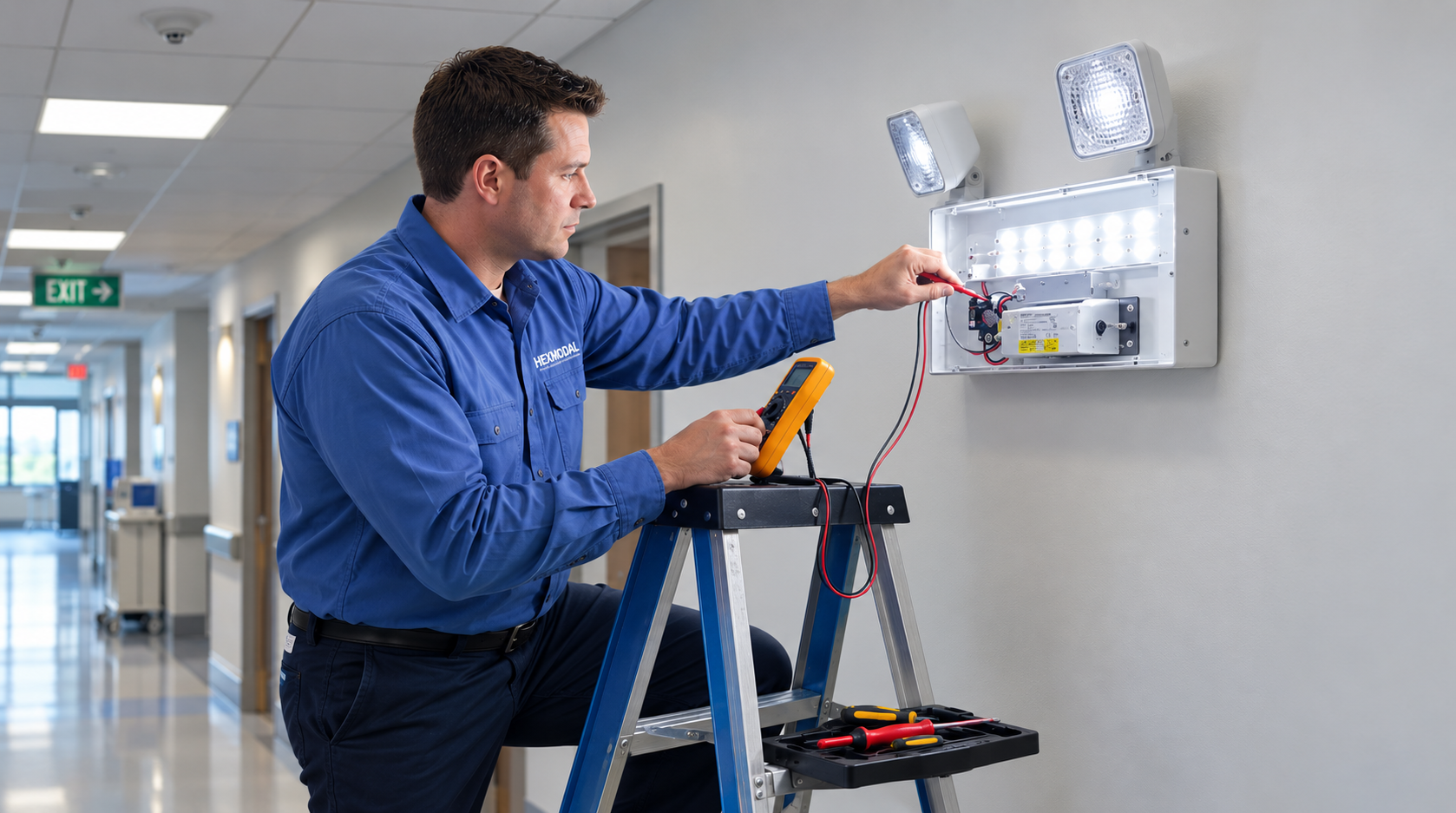
Once a month, you need to confirm that each emergency light can switch from normal power to its emergency source and stay lit for at least 30 seconds. That short test checks the transfer circuitry and lamps while using only a small amount of battery capacity.
NFPA 101 sets 30 seconds as the minimum duration for the monthly test. You can run the test for longer, but the annual test serves a different purpose. It checks how long the battery can actually sustain the fixture under load.
1. How the monthly test works
To run the test, interrupt normal power to the fixture using its test button or by opening the branch circuit. Then watch the lamps for the full 30 seconds. You want every lamp to illuminate promptly and stay on until the test ends.
Pay attention to what happens after you restore normal power, too. A lamp that stays dark, cuts out before 30 seconds, or fails to resume normal charging can indicate a problem that needs attention. Record the fixture location and pass or fail result after each test so you have a clear history of what happened.
2. How often should emergency lights be tested?
Here is where the word “monthly” can trip teams up. Under the 2012 edition, NFPA 101 defines the interval as 3 to 5 weeks between tests. So, testing once during each calendar month does not automatically satisfy the interval.
For example, a test on January 2 followed by one on February 27 covers two calendar months but leaves an eight-week interval. A fixed testing day, such as the first Tuesday of every month, gives your team a simple way to keep each test within the required window.
What Is the 90-Minute Annual Emergency Lighting Test?
Battery-powered emergency lighting must run on battery power for at least 90 minutes once every 12 months. That duration aligns with Section 7.9.2.1, which requires emergency illumination for at least 1½ hours after normal lighting fails.
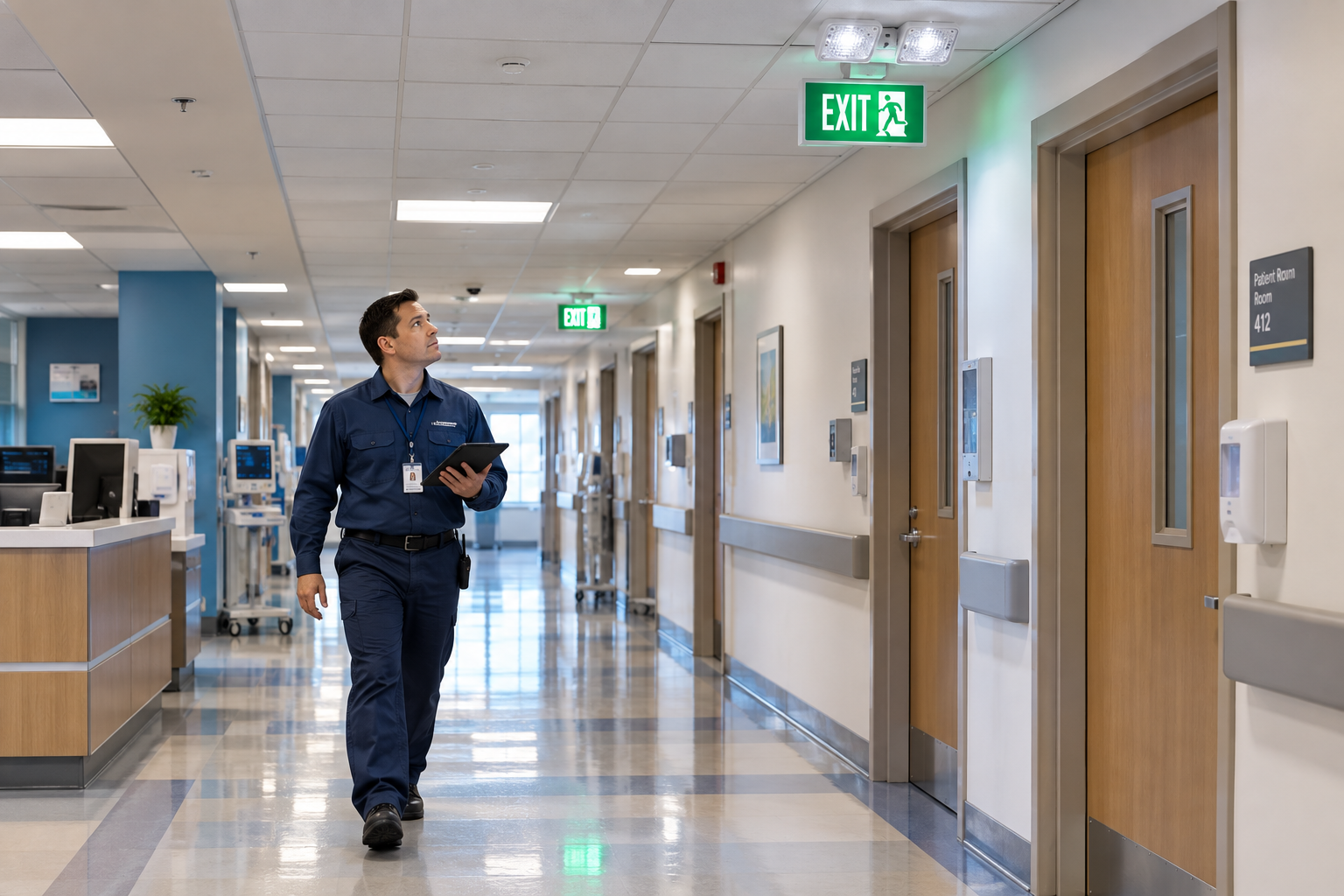
The annual test answers a different question from the monthly check. A fixture can pass a 30-second test and still lose battery capacity well before the 90-minute mark. Running the fixture under load for the full 90 minutes gives you a clearer picture of whether the battery can sustain the required illumination.
Generator-supplied emergency lighting follows separate requirements under NFPA 110. The 90-minute test discussed here applies to unit equipment with its own batteries and to central battery systems.
1. How to test emergency lights for 90 minutes
A 90-minute test takes more planning than the monthly check, particularly in an occupied building. You need to protect normal operations while keeping every test result traceable. Follow the manufacturer's instructions for the specific fixture alongside these steps.
- Schedule the testing window: Choose a low-occupancy period and divide the building into zones so neighboring areas retain charged fixtures while one zone recharges.
- Notify affected departments: Let security and clinical leads know which zone will go on test and when normal lighting will return.
- Interrupt normal power: Use the fixture's test function or open the branch circuit serving the zone, then record the start time.
- Check output at the start: Walk the zone and confirm that every fixture switches to battery power.
- Run the full 90 minutes: Keep normal power off for the entire test, including for fixtures that appear to be operating normally early in the test.
- Check output at the end: Walk the zone again before restoring power and record any fixture that went dark, including when it failed.
- Restore power and check charging: Confirm that charging indicators return and allow the manufacturer-specified recharge period before relying on those fixtures again.
- Follow up on failures: Assign failed fixtures for repair and schedule a retest after the technician completes the work.
2. What should happen during the 90-minute test?
Every fixture should remain operational throughout the test. NFPA 101 requires the equipment to remain fully operational for the full duration, while Section 7.9.2.1 allows illumination to decline to 60 percent of its initial level by the end of the 1½ hours.
Some dimming toward the end can therefore fall within the code. A fixture that goes dark before 90 minutes fails the test. The point at which it fails can also help your team investigate the problem. An early cutoff can indicate a battery-capacity issue, while an immediate failure can point toward the transfer circuit or lamp.
3. What Does NFPA 101 Section 7.9.3 Require?
Once you understand the two tests, the next question is how your team can carry them out. Section 7.9.3 provides three testing pathways, with each one placing different parts of the testing and recordkeeping process in the hands of staff or automated equipment.
You can use more than one pathway across a facility, depending on the equipment installed in each area. The objective stays the same throughout the building. You need evidence that each required fixture performs for the required duration and that the testing history remains available for review.
Equipment listing is a separate part of the picture. UL 924 covers the listing of emergency lighting and power equipment, and NFPA 101 references it for internally illuminated exit signs. The listing addresses the equipment itself, while Section 7.9.3 addresses how you test and maintain that equipment over its service life.
3a. Manual functional testing
Section 7.9.3.1.1 describes the conventional approach. Your staff perform the 30-second test each month and the 90-minute test each year, then record the results for the AHJ.
That workload may be manageable in a smaller building with a few dozen fixtures. As the fixture count grows, so does the testing effort. A hospital with 1,000 fixtures, for example, would generate 12,000 monthly checks each year before you add the annual tests.
3b. Self-testing and self-diagnostic equipment
Section 7.9.3.1.2 covers fixtures that run their own 30-second test and diagnostic routine at least once every 30 days. These fixtures signal failures through a status indicator, typically an LED on the housing.
With this equipment, you replace the monthly staff-performed functional test with a visual inspection at intervals of 30 days or less. Your team still needs to check each fixture's indicator, and the annual 90-minute test remains part of the program.
3c. Computer-based automatic testing under 7.9.3.1.3
Section 7.9.3.1.3 allows computer-based self-testing and self-diagnostic battery equipment when it meets four conditions:
- It automatically runs a test of at least 30 seconds and a diagnostic routine at least once every 30 days.
- It automatically runs a test of at least 1½ hours once a year.
- It remains fully operational throughout both tests.
- The computer-based system can report the history of tests and failures at all times.
That last requirement matters because automation has to produce more than a completed test. You also need a retrievable record of what happened. When a surveyor asks for a fixture's testing history, the system needs to provide that record without your team having to reconstruct it from individual logs.
Before you rely on this pathway, confirm with your AHJ that the specific system qualifies and clarify which visual inspection activities still apply.
4. Emergency Lighting Testing vs. Visual Inspection
Testing proves a fixture runs on emergency power, and inspection confirms the conditions a person can see. An emergency lighting inspection catches a cracked lens or a fixture hidden behind new shelving, and it confirms the status indicator shows a charged battery.
Each activity answers a separate question, so a compliance program needs both. A fixture can pass a 30-second test while aimed at a blank wall, and a clean, well-aimed fixture with a weak battery passes a visual check while failing at minute 40.
Treating them as interchangeable leaves gaps that surface during a survey. Keep them as separate entries in the record, each with its own date.
5. Emergency Lighting Testing Requirements for Hospitals
Hospitals run the same monthly and annual tests as other buildings, and they also face CMS and accreditation surveys that review each test record. CMS requires covered healthcare providers and suppliers to comply with the 2012 edition of NFPA 101, a requirement set in its 2016 Life Safety Code final rule.
Accrediting organizations such as The Joint Commission and DNV survey against that same edition.
The survey question goes beyond working lights. Surveyors want evidence that every required test happened on schedule, along with the corrective action for anything that failed.
Scale adds pressure. A health system can hold thousands of fixtures across hospitals and medical office buildings, and each fixture generates 12 monthly entries plus one annual entry every year. That volume makes emergency lighting testing requirements for hospitals a records-management task as much as a maintenance task. The Hexmodal hospitals page covers how this plays out across a full campus.
5a. What CMS surveyors may look for
CMS surveyors check for a record of each required monthly and annual test, with dates showing the testing interval held. Emergency lighting findings appear under K-tag K291 in the Life Safety Code survey process.
Deficiency citations published in CMS's Quality, Certification, and Oversight Reports (QCOR) database include emergency lighting findings tied to missing monthly or annual test documentation. A failure logged without a repair or retest leaves the surveyor with an open question, a pattern covered in more depth in preventing CMS deficiencies.
5b. What The Joint Commission expects
The Joint Commission's FAQ on battery-powered emergency lighting applies the monthly 30-second test and the 90-minute test every 12 months, including lighting used for exit signs. The same guidance states that organizations document test results along with completion dates.
A surveyor can therefore ask for a single fixture's records, and the facilities team should be able to produce the date and result for each required test.
What Records Should Emergency Lighting Testing Produce?
A survey-ready record identifies the fixture and shows the outcome of each test on a specific date. Failures need a second layer showing what happened next.
Paper logs capture these fields one clipboard at a time, and gaps appear when a page goes missing or a round gets skipped. Emergency lighting test records kept digitally attach every field to the fixture itself, so a surveyor's request becomes a search across one system. Simplifying compliance reporting walks through that shift.
Digital records also make interval checks automatic. A report can flag any fixture whose last test falls outside the 3-to-5-week window before a surveyor finds it.
1. Can Emergency Lighting Testing Be Automated?
Yes, through the computer-based self-testing pathway in NFPA 101 Section 7.9.3.1.3. Equipment on that pathway runs both the 30-second and 90-minute tests on its own and reports a test and failure history on demand.
A system that schedules tests without keeping a retrievable history falls short of the pathway. The history requirement carries as much weight as the tests themselves, since it replaces the written log the manual pathway depends on.
1a. What automated testing changes
Tests run on schedule with no technician at each fixture, and results post to a central history as each test finishes. Failures trigger an alert, so the maintenance team learns about a weak battery the day it fails the test.
Monthly rounds shift from pressing buttons to fixing the fixtures the system flags, the workflow described in eliminating manual testing.
1b. What stays the same with automation
The facility owner remains responsible for compliance, and the AHJ decides if a given system meets the pathway. Repairs stay hands-on work, since a failed battery needs a technician to replace it.
Visual checks for damage and obstructions also remain good practice, and some AHJs require them on a schedule. Treat automation as a replacement for the test itself, with the surrounding maintenance program kept intact.
2. What Happens When an Emergency Light Fails a Test?
A failed fixture needs a repair followed by a retest, with both steps recorded against the original failure. Treat the failure as an open item from the moment it appears.
Common causes include a battery past its service life or a failed charging circuit. Replace batteries with the part the manufacturer specifies, since substitutes may affect the fixture's listing.
After logging the repair against the original failure, rerun the test and attach the new result to the same record. That chain from failure to retest is what a surveyor reads as closure.
Hospitals face an added step when a failure affects egress lighting and the repair takes time. The facility's interim life safety measures (ILSM) policy may call for compensating actions until the fixture passes.
How Hexmodal Automates Emergency Lighting Testing
Hexmodal Smart Emergency Lights and Exit Signs run the monthly 30-second test and the annual 90-minute discharge test automatically, following NFPA 101 Section 7.9.3. Each fixture reports its pass or fail result to the Hexmodal Dashboard, which removes routine test-button rounds from the facilities calendar.
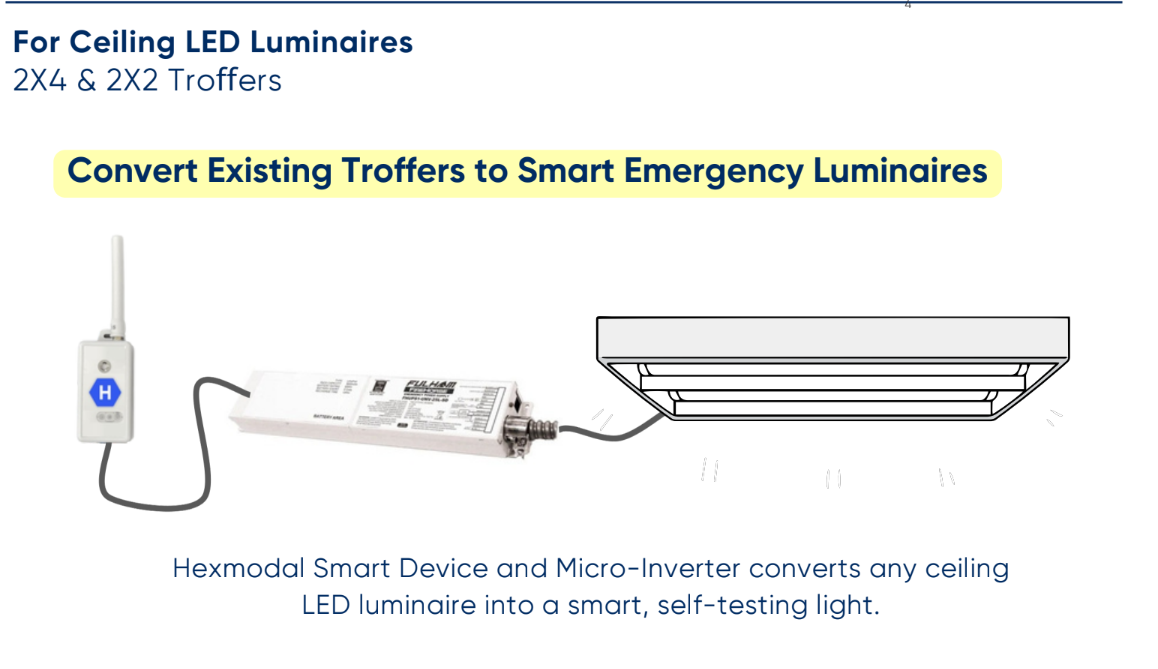
Existing ceiling troffers can be converted into smart emergency luminaires using the Hexmodal Smart Device and Micro-Inverter. This approach adds self-testing capability to existing LED fixtures without replacing the entire luminaire.
The dashboard keeps a complete test history for every fixture, including failure details and maintenance comments. Failed tests trigger alerts, and each corrective action stays attached to the original report until the issue closes. Reports come formatted for the AHJ, so the records described above are ready when a surveyor asks.
Fixtures send data over low-frequency radio to a cellular gateway, so the system runs independently of the facility's WiFi and Ethernet. Installation uses standard junction boxes and 110 to 270 VAC power, which lets facilities staff mount fixtures during routine maintenance.
Reviewing your testing program? Talk to the Hexmodal team about how automated testing would work across your buildings.
Frequently Asked Question
1. How often should emergency lights be tested?
Every month for at least 30 seconds, and every year for at least 90 minutes when battery-powered. Pairing the monthly test with a visual check of the housing and indicator covers both tasks in a single visit.
2. What is the 30-second emergency light test?
A monthly functional test confirming the fixture switches to battery power. Start the count once the lamps light on battery and watch the full 30 seconds, since a fixture that cuts out at second 20 fails.
3. How do you test emergency lights for 90 minutes?
Cut normal power to one zone at a time and keep it off for the full duration, checking output at the start and the end. For central battery systems, start the test at the battery cabinet and walk every remote head on the circuit.
4. What happens if an emergency light fails the 90-minute test?
Record the failure time and open a work order. After the repair, rerun the full 90-minute test, since a 30-second check after a battery swap leaves capacity unproven.
5. Can emergency lighting testing be automated?
Yes, under NFPA 101 Section 7.9.3.1.3, provided the system meets its testing and reporting conditions. Self-testing replacement fixtures let a facility automate gradually, swapping units as older fixtures reach end of life.
6. Do emergency lights still need visual inspections?
Self-testing equipment under Section 7.9.3.1.2 requires a visual inspection every 30 days or less. Exit signs carry their own visual inspection requirement at the same interval under Section 7.10.9.1.
7. What records are required for emergency lighting testing?
Each record ties a dated result to a specific fixture, with corrective action added for failures. Recording the testing pathway alongside each entry helps a surveyor apply the right interval rules.
8. Do hospitals have different emergency lighting testing requirements?
The battery tests match other occupancies, with CMS enforcing the 2012 edition. Hospital lighting supplied by the essential electrical system follows generator testing rules in NFPA 99 and NFPA 110 in place of the 90-minute battery test.
Author:
Chris Hariz
Category:
Date:
September 24, 2026
Keep reading
Related Articles

Schedule Your Demo
Demo request received
Someone from the team will be in touch shortly to schedule your demo.
Something Went Wrong
Your request couldn’t be submitted. Please try again or refresh the page.