.svg)
NFPA 10 allows electronic monitoring in place of the monthly extinguisher inspection once your AHJ approves it in writing. Guide covers which code edition applies, what monitoring can and can't verify, and how to build your approval case.
Article
NFPA 10 Electronic Monitoring: What the Code Permits and How AHJ Approval Works

Christian de Abreu
Compliance
October 6, 2026



Key takeaways
- NFPA 10, the National Fire Protection Association (NFPA) extinguisher standard, accepts electronic monitoring for the 30-day inspection once the Authority Having Jurisdiction (AHJ) approves it.
- The allowance traces back to a 2006 amendment and sits in NFPA 10-2010 Section 7.2.1.2, the edition federal surveyors still apply in hospitals.
- The 2026 edition adds a separate performance-based program that can extend or reduce inspection frequency.
- Monitoring replaces the monthly check alone, so confirm your adopted edition, keep your technician contract for longer intervals and secure written AHJ approval first.
- Hexmodal monitors pressure, weight, location, obstruction and tampering on existing extinguishers, producing the time-stamped records and pilot data an AHJ reviews.
Every facilities manager weighing NFPA 10 electronic monitoring starts by asking whether the monthly extinguisher round can stop. It can, once the Authority Having Jurisdiction (AHJ) approves the monitoring method in writing. NFPA 10 has treated electronic monitoring as a valid monthly inspection method since a 2006 amendment. The 2010 edition, which hospitals still answer to under federal rules, carries that language.
The harder part is the approval itself. What follows traces the edition's history and sets out an approval path you can take into a fire marshal's office. It also draws a clear line between sensor work and contractor work.
Does NFPA 10 Allow Electronic Monitoring Instead of Monthly Inspections?
Yes. NFPA 10 treats electronic monitoring as an approved way to carry out the monthly inspection, with the 30-day obligation intact. The NFPA 10-2010 edition allows extinguishers to be inspected manually or by an electronic monitoring system at 30-day intervals, with the AHJ approving the method.
That distinction between interval and method shapes the proposal you write. The fire marshal approves a new way to meet an existing requirement, and a request framed that way reads as a compliance plan.
Atlantic Health reports 10,050 hours saved after automating its compliance testing with Hexmodal. Hexmodal's approach to eliminating manual testing moves the monthly check onto the device and files each result as a time-stamped record.
To size that change for your own campus, see what monitoring would cost for your extinguisher count.
When Did the Code Start Permitting It?
The permission first appeared through a 2006 amendment to NFPA 10 and NFPA 72. Electrical Contractor magazine reported that the change added a definition of electronic monitoring to NFPA 10 along with detailed provisions in Chapter 7.
NFPA 10-2010 carries the allowance in Section 7.2.1.2, and state health departments cite it in guidance to licensed facilities. The Minnesota Department of Health's summary of NFPA 10-2010 permits electronic monitoring as an alternative to the monthly visual inspection. A 2021 Indiana Department of Health survey report quotes Section 7.2.1.2 directly in a statement of deficiencies.
The 2026 edition makes a different change. NFPA's own listing for the edition describes new Chapter 7 requirements for a performance-based inspection program that can extend or reduce inspection frequency. That provision governs how often inspections happen, while the monitoring allowance governs how they happen.
Some commentary on the 2026 edition quotes Second Draft Report language, which was a committee proposal during the revision cycle. Check any section number against the printed 2026 edition, since that edition renumbered parts of Chapter 7.
The 2026 summaries in circulation are accurate on local adoption and on the AHJ's authority to approve, and one claim in them needs correcting.
The claim: Several 2026 code summaries present electronic monitoring as a permission the 2026 edition introduced. A facilities team reading them concludes it has to wait for local adoption of that edition.
The record: NFPA 10-2010 Section 7.2.1.2 already permits inspection by electronic monitoring at 30-day intervals. Your Authority Having Jurisdiction (AHJ) may enforce an edition that allows monitoring today.
Which Edition Does Your Jurisdiction Actually Enforce?
Your facility answers to the NFPA 10 edition written into your state or local fire code, which can trail NFPA's latest by years.
NFPA issues an edition, and each state or municipality decides when to adopt it, commonly through the International Fire Code (IFC) edition that references it.
A jurisdiction on an older edition can still permit monitoring, because the allowance reaches back to 2010. The performance-based frequency program becomes available once your jurisdiction adopts the 2026 edition, and that date may sit years away.
It's best to confirm the edition before you draft anything. Call the fire marshal's office and ask which NFPA 10 edition it enforces, including any local amendments to Chapter 7. Then check the state fire code adoption record and ask your accreditor which edition its surveyors cite.
Table 1: Where to confirm the NFPA 10 edition that applies to your facility.
What Conditions Does Monitoring Have to Cover?
Monitoring has to verify every condition a person checks on the monthly round, starting with location and clear access. NFPA 10-2010 Section 7.2.2 lists the full set, from gauge pressure through to legible operating instructions.
The value of continuous monitoring shows up between rounds. A manual inspection confirms a unit's condition on the day someone looks, and a sensor reports on the day the condition changes.
Hexmodal's smart fire extinguisher monitoring fits existing ABC extinguishers from 5 lb to 20 lb, mounted on the wall or inside a cabinet. Each unit reports pressure and weight continuously, and every inspection record carries a gauge image for the reviewer.
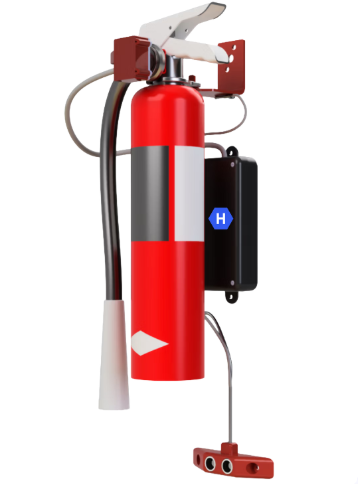
Where a unit sits outside what the system verifies electronically, NFPA 10-2010 calls for continuous location monitoring of that unit.
A sensor leaves some checks to a person. Physical damage and corrosion need human eyes, and so does the legibility of operating instructions. Propose how your team covers those checks, for example during scheduled floor rounds. The AHJ then rules on whether that arrangement meets the monthly requirement.
Table 2: Monthly inspection conditions and how Hexmodal monitoring records each one.
What Still Requires a Certified Technician?
Annual maintenance and the internal and pressure tests that follow it still require a certified technician, whichever method covers the monthly check.
The annual visit includes a full mechanical examination of each unit and ends with a new maintenance tag. Stored-pressure dry chemical units also require an internal examination every six years, while hydrostatic testing falls due at 5 or 12 years, depending on extinguisher type.
Budget for the service contract as before, since monitoring changes the monthly interval only. The NFPA 10 inspection schedule article covers every interval in detail for hospital teams.
How Do You Get AHJ Approval?
You earn approval by showing the AHJ exactly what the system checks and what happens when a check fails.
It may help to start with the fire marshal's office. In a hospital, involving your Director of Environment of Care (EOC), regularory or life safety lead early can make the first meeting more productive. It can also help to have evidence ready for review, such as a sample inspection record and your alert escalation chart. A floorplan marking every monitored unit can also clarify the location and coverage of the system.
A pilot on one building or floor may also be worth considering. This gives the AHJ an opportunity to review live records before considering campus-wide approval, while giving your team time to tune alerts. Hexmodal's implementation team can also confirm at go-live that reports generate in the format your AHJ expects, which can help simplify discussions around record layout.
Your AHJ approval checklist
- Document which monthly conditions the system monitors and the method behind each one.
- Show the record format with its timestamps, and state your proposed retention period.
- List the units that sit outside electronic verification and explain how you monitor their location.
- Agree who receives alerts and the response time for each alert type.
- Obtain written approval from the AHJ before the manual round stops.
What Does the Record Have to Show?
For each extinguisher, the record has to show when the check happened and what it found, with any corrective action tied to the original event.
NFPA 10-2010 Section 7.2.4 accepts electronic records alongside tags and paper checklists, so one complete electronic record meets the requirement. Where a monitored unit signals a control unit in a deficient condition, NFPA 10-2010 expects the system to produce an electronic event log.
Each entry should carry the unit's identity and floorplan location. It should also hold the timestamp and result, and any corrective action should name the person who closed it. Agree the retention period with the AHJ as part of the approval letter.
Keep one authoritative record per unit. A monitored extinguisher carrying a stale monthly tag beside an electronic log invites a surveyor to ask which one is current. Hexmodal's automated reporting produces AHJ-formatted records from the monitoring data. When a unit fails, its CMMS integration opens a work order in your Computerized Maintenance Management System (CMMS). The fix then writes back to the original event.
What Changes for a Hospital?
A hospital answers to the federal survey process as well as the local AHJ, and the federal edition already contains the monitoring allowance.
CMS enforces the 2012 edition of the Life Safety Code (NFPA 101), which references NFPA 10-2010 for portable extinguishers. Surveyors record extinguisher findings under tag K355 on the Life Safety Code survey form. Joint Commission and DNV apply the same CMS requirements when they survey hospitals with deemed status.
In practice, a Medicare-certified hospital already works under an edition that permits monitoring. File the AHJ's approval letter in the same digital binder as your inspection records, so a surveyor sees the permission and the evidence together. Hexmodal's hospital compliance setup and its guidance on preventing CMS deficiencies follow that model.
Hospital IT review is the other hurdle, and it applies to deployment instead of the code. Hexmodal devices report over LoRaWAN radio to a Hexmodal gateway that connects by cellular, keeping every sensor off the hospital network. Eden Medical Center used that setup to begin real-time monitoring without involving its IT team, the approach Hexmodal describes as avoiding IT barriers.
Where This Leaves Your Monthly Round
NFPA 10 has permitted electronic monitoring for the monthly inspection since the 2010 edition, and the 2026 edition adds a separate route for adjusting inspection frequency. The work in front of your team is the approval, built on a confirmed edition and a documented monitoring method.
Once the AHJ signs off in writing, the monthly round can retire while the technician contract carries on. Talk to the Hexmodal team about scoping a pilot for your AHJ review.
Frequently Asked Questions
1. Is electronic monitoring new in the 2026 edition of NFPA 10?
Earlier editions permit it, including NFPA 10-2010. The 2026 addition is a performance-based program for adjusting inspection frequency, and that program applies once your jurisdiction adopts the 2026 edition.
2. Does a monitored extinguisher still need a physical tag?
The monthly inspection can live entirely in the electronic record. The annual maintenance tag your technician attaches stays on the unit, since maintenance remains a hands-on service with its own tagging requirement.
3. Who performs the monthly inspection while approval is pending?
Trained facility staff handle it, as they do today. Certification requirements apply to annual maintenance and the longer intervals, so your existing monthly process continues until the AHJ signs off.
4. How are units outside electronic verification handled?
List them by unit ID in your approval proposal. NFPA 10-2010 calls for continuous location monitoring of those units, and the AHJ may add manual checks.
5. Does OSHA accept electronic monitoring?
The Occupational Safety and Health Administration (OSHA) requires a monthly visual inspection under 29 CFR 1910.157(e)(2). A 2006 interpretation letter held that frequency firm. Confirm with safety counsel how your monitoring program satisfies the visual requirement.
6. How long does AHJ approval usually take?
Timelines vary by jurisdiction and by how complete the first submission is. A package that includes pilot data and a sample record gives the reviewer everything in one meeting and shortens the exchange.
Author:
Christian de Abreu
Category:
Compliance
Date:
October 6, 2026
Keep reading
Related Articles



Schedule Your Demo
Demo request received
Someone from the team will be in touch shortly to schedule your demo.
Something Went Wrong
Your request couldn’t be submitted. Please try again or refresh the page.