.svg)
Every fire extinguisher inspection interval in one place: monthly checks, annual maintenance, 6-year examination, and hydrostatic testing, with the records each one produces.
Article
The End-to-End Fire Extinguisher Inspection Checklist: Monthly, Annual, 6-Year, and 12-Year Requirements

Chris Hariz
Compliance
September 18, 2026



When a surveyor asks for twelve months of fire extinguisher inspection records, your answer rests on four separate intervals. Different people perform each one, and each leaves a different record behind. Monthly inspection and annual service come first, while the 6-year internal exam and the 12-year pressure test arrive later. Those last two apply to some of your extinguishers and skip others entirely.
In this blog, you get the full inspection schedule in one place, from what you check at each interval to who is allowed to do the work. Each section names the record that interval leaves behind, and the later sections show where electronic monitoring fits.
Every interval here comes from NFPA 10, 2026 edition, the standard for portable fire extinguishers. Jurisdictions adopt different editions of it, so confirm which one your Authority Having Jurisdiction ( AHJ) enforces before you build a program around any schedule below. Hospitals are the common exception and Centers for Medicare & Medicaid Services (CMS) enforces the 2010 edition, and the differences that matter are flagged where they appear.
See how automated monitoring records your monthly extinguisher inspections.
What Does NFPA 10 Require, and Who Enforces It?
NFPA 10, 2026 edition, sets how often you inspect, service and test each extinguisher, and what record each job leaves behind. Your AHJ picks an edition and enforces it in your area.
As per Chapter 7 and 8, parts of the standard carry your schedule:
- Inspection: a quick visual check every 31 days.
- Service: annual maintenance, plus the 6-year internal exam on units that qualify.
- Testing: a pressure test on a cycle set by extinguisher type.
Every interval also calls for a record, and your paperwork counts as much as the work. An extinguisher you checked correctly all year still draws a finding when one month's record goes missing or sits with a vendor who has since changed hands.
Hospitals face a second layer. CMS K-tag K355 requires extinguishers to be inspected under NFPA 10, and the CMS Conditions of Participation tie your compliance to reimbursement. The Joint Commission and DNV ask for the same paperwork during the survey, so one missing record can surface in three separate reviews.
How Often Do Fire Extinguishers Need to Be Inspected?
You must inspect your fire extinguishers every 31 days or sooner. You must also check each unit by hand the first time you put it into service.
1. The 31-day inspection requirement
An inspection is a quick visual check that the unit sits where it belongs and looks ready to work. It requires no certification, which is why anyone on your staff can perform the monthly round, and it is brief enough that the standard asks for it every 31 days rather than annually. (Annex A.7.1, NFPA 10 2010)
The 31-day wording matters more than the word "monthly." An interval is the gap between two checks, so your clock will run from your last inspection instead of from the first of the month. If you check a unit on March 1 and again on April 5, you will have missed the interval, even though each month shows one entry.
2. When extinguishers need more frequent inspections
Some spots need checking more often, and NFPA 10 points to the conditions that shorten the gap. Each one describes a way a unit can fail between your visits:
- A history of frequent fires: units here get used, so one may sit empty while it still looks fine from a distance.
- Severe hazards nearby: a failed extinguisher matters more in a space where a small fire spreads fast.
- Tampering, vandalism or theft: someone can pull a pin or walk off with a unit the day after you sign the tag.
- Knocks and physical damage: carts and equipment dent shells and crack gauges in busy corridors.
- Harsh heat or corrosive air: heat and chemicals eat at cylinders and seals, and pressure drifts as a result.
- Units that tend to leak: some designs lose pressure slowly, so a longer gap lets more of it escape before anyone notices.
The standard also points out that you can run these more frequent checks electronically, which matters once you are watching a large group of units in rough conditions.
3. Different requirements for vehicle-mounted extinguishers
Extinguishers on vehicles work on a different clock. NFPA 10 points to checking them at the start of a shift, or any time the vehicle is used. For example, a truck bounces its extinguisher around all day, so the trigger for these units is each trip instead of a date on the calendar.
4. Why hospitals still inspect monthly
Hospital facilities teams often ask whether the monthly interval is proportionate to hospital risk. The question reached the NFPA 10 technical committee during the 2025 revision cycle that produced the 2026 edition.
During the 2025 revision cycle, the American Society for Health Care Engineering submitted data covering 291,476 monthly hospital inspections. Those checks turned up 269 problems, a failure rate of 0.092%. ASHE argued that so few failures across so many checks means the monthly round costs hospitals more labor than it returns in safety, and it proposed a quarterly interval for buildings holding a hospital.
The NFPA 10 technical committee turned the proposal down. NFPA 10, 2026 edition, applies to portable fire extinguishers in every occupancy, so the committee could not lower the frequency for hospitals without lowering it for every building type the standard covers.
That has a practical consequence for your program. A low failure rate across your own portfolio does not by itself earn a longer interval, so the route to a different inspection method runs through the performance-based program in NFPA 10, 2026 edition, covered further down.
Table 1: The four intervals, who handles each one and the record it produces. Intervals shift by extinguisher type, covered further down.
What Do You Check During a Monthly Fire Extinguisher Inspection?
Seven conditions make up the monthly check under 7.2.2 of the 2026 edition.
- Sitting in its assigned place: a unit moved two rooms down is missing for whoever needs it here.
- Visible, or its location marked: someone in a smoke-filled corridor has seconds and poor sight, so the sign is what makes it findable.
- Clear path to it: a blocked extinguisher may as well be absent during the minute it is needed.
- Gauge in the working range: the gauge is your only outside view of whether the unit still holds pressure.
- Full, judged by weight: self-expelling, cartridge-operated, pump tank and wheeled units carry no gauge reading you can trust.
- Wheeled unit parts in working shape: a flat tire keeps the unit away from the fire, and a cracked hose stops the agent reaching it.
- Push-to-test indicator working: non-rechargeable units have no service path, so the indicator is your one signal.
1. Which of your extinguishers need the longer inspection
Three extra checks apply in rough spots only. The seven basic checks assume a quiet indoor location where the unit sits undisturbed. Heat, chemicals, traffic and heavy handling break that assumption, so the standard adds:
- Operating instructions readable and facing out: whoever grabs the unit may be reading that label for the first time, under stress.
- Safety seals and tamper indicators whole: a broken seal tells you someone already pulled the pin, so the unit may hold less agent than the gauge suggests.
- No damage, rust, leaks or blocked nozzle: damp air and knocks weaken a shell over months, well before it looks wrong from across the room.
Your loading dock, kitchen and mechanical rooms usually qualify. A patient corridor usually falls outside those conditions, since the environment stays steady and staff pass by all day. Class D agent containers follow their own six-item list.
2. What to do when an extinguisher fails your monthly inspection
You must fix any problem right away. A unit that fails your check is out of service from that moment, so the area it covers sits unprotected until you deal with it.
What happens next depends on the unit, because some can be restored and others have reached the end of their life:
- Rechargeable units: these carry a serviceable valve, so a certified technician refills and repressurizes them, then they return to the wall.
- Non-rechargeable dry chemical units: no service path exists. You pull them, discharge them, then destroy them as your AHJ directs or send them back to the maker.
- Non-rechargeable halon units: these come off the wall still charged and go back for agent recovery, since halon is a controlled substance.
NFPA 10 maps common defects to actions, and the table is worth keeping within reach of your team. It separates the problems a technician settles on the spot from the ones that send the cylinder away for testing or destruction. A low gauge points to a refill and a leak test. A deep dent points to a judgment call on whether the cylinder survives at all.
Table 2: Common monthly inspection problems and the action NFPA 10 points to.
With Hexmodal you choose who gets each alert, by room, building, device group or user group, and alerts reach your team by text, email or phone. Connect your CMMS and each event opens a work order carrying the device, location, event type and time, then the fix comes back attached to your original record. An electronic alert counts as a trigger for service, so that loop matches what the standard describes.
3. How long do you need to keep monthly inspection records?
You must keep twelve months of inspection records. (Annex 7.2.4.1.5, NFPA 10, 2026) A surveyor works backward across a full year, so your file needs every interval covered from today to the same date last year. One missing month breaks the run.
You can hold that record three ways, each with a trade-off:
- A tag on the extinguisher: the record travels with the unit, though a tag that goes missing takes the whole year with it.
- A checklist in a file: one sheet covers a floor or building, and it holds up as long as someone keeps filing on time.
- An electronic record: entries stay readable and searchable, and your system produces the twelve inspections on demand.
Each handwritten entry must carry the month, the year and the initials of whoever checked the unit. Pick one form and stay with it. Keep three and a surveyor who finds your tag and your spreadsheet disagreeing will write up the conflict.
One audit question comes up often. You can skip the separate monthly record for the month your annual exam takes place, because that exam covers the same items. Teams often log a gap here that was never a gap.
With Hexmodal, your record is created and time-stamped as the monitoring happens, so your twelve-month history builds itself. Continuous monitoring builds the inspection record as status data is collected, so your documentation stays available between surveys instead of being assembled when a survey is announced.
Your Digital Binder keeps inspection records, test history, gauge photos, corrective actions and reports in one searchable place. A records request during a survey becomes a quick search instead of a hunt through buildings and binders.
Can Electronic Monitoring Replace Your Monthly Manual Inspection?
Yes, with two conditions attached. NFPA 10 accepts electronic monitoring as a way of performing the inspection and requires your AHJ to approve any method other than a hands-on check. Both apply together, so a system running without written approval meets neither.
What the standard asks of you:
- You can pick the method: Hands-on checks, monitoring or a mix of both are all open to you.
- One hands-on step stays: You must still check a monitored unit by hand when a signal shows someone lifted it off its bracket.
- The system watches itself: Your link to each device and your power source must both stay supervised for continuity.
- Records show twelve inspections: Your records must show the last twelve, and any problem flagged at a control unit must land in an event log at the panel.
You can run those more frequent checks electronically too, which helps where units sit in corrosive or busy areas.
1. Which monthly checks you can monitor with Hexmodal
Hexmodal performs the monthly inspection for you. Rather than a single check every 31 days, the system monitors continuously, so the conditions it covers are verified around the clock and your record builds itself as it goes.
Hexmodal uses three types of sensing to cover the conditions that can be monitored electronically.
- The Smart Hook confirms the extinguisher remains in its designated location and detects tampering.
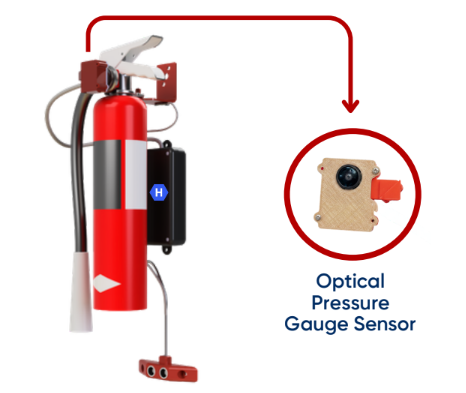
- The Optical Pressure Gauge Sensor captures the gauge condition.
- The Obstruction Sensor continuously confirms the area around the unit stays clear. Where fullness must be verified by weight, the system monitors each unit against its established baseline.
Two of the seven conditions, wheeled unit components and the push-to-test indicator on non-rechargeable units, are handled at your annual examination rather than monitored continuously. If you own wheeled or non-rechargeable units, you keep a short manual round for those and monitor everything else.
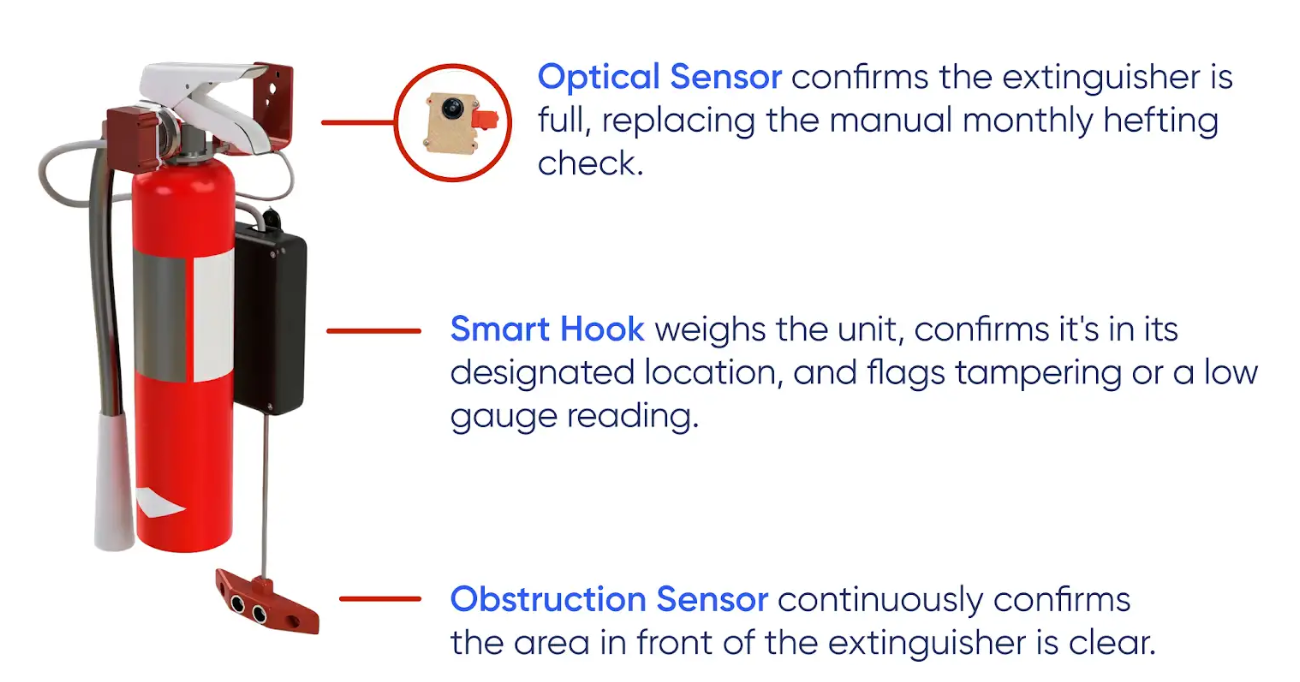
Table 3: The checks you can monitor with Hexmodal, and the two that stay hands-on.
If you own wheeled or non-rechargeable units, you keep a short manual round for those and monitor everything else. You also get tamper data, which sits outside the seven checks and counts as a reason to inspect more often.
A manual inspection gives you a point-in-time view of each extinguisher once every 31 days. Continuous monitoring instead keeps track of the conditions the system can sense between inspections, so a change in location, access, gauge condition or device status can generate an alert when it occurs.
2. What electronic monitoring leaves unchanged for you
Monitoring covers covers the monthly inspection interval only. Your annual service, the 6-year internal examination, pressure testing and the certified technician requirement all continue exactly as they are.
The labor case still holds with all of that in place. Monthly is the interval that comes around twelve times a year, and it is the only one you can automate. Hexmodal’s Fire Extinguisher Savings Calculator estimates that managing 2,000 devices by hand eats roughly 3,000 labor hours a year. At 1.5 hours per inspection, that is equivalent to the workload of nearly a full-time employee on your team.
3. How to get AHJ approval for electronic monitoring
Four steps, in order:
- Document your coverage: Write down which of the seven monthly checks your system monitors and which stay hands-on.
- Show the record format: Demonstrate the twelve-inspection history and the event log your system produces.
- Confirm supervision: Show that your device connections and power source stay supervised.
- Get it in writing: Secure approval before you drop the manual round.
The order matters. Drop your round first and ask afterwards, and you create a records gap for every month in between, which then sits in your file for a year.
Hexmodal implementation includes go-live checks, so you confirm your reports come out the way your AHJ expects before you rely on them.
Is There an Alternative to Monthly Inspections? Performance-Based Programs Explained
A performance-based program is an alternative route to compliance. Instead of following the prescribed inspection rules, you demonstrate with your own data that your extinguishers stay in working condition, and your AHJ approves that demonstration in place of the standard method. NFPA 10 introduces this at 7.2.5 in the 2026 edition. It does not appear in the 2010 edition, so a hospital enforced to the same cannot adopt one today.
That timing is the useful part. The program rests on three years of monthly inspection data, so the real constraint is history. A facility that starts capturing per-device data now arrives at adoption with the record already built. A facility that waits for the edition to change waits another three years after that.
Few limits shape the program. Your inspection interval must still stay within 30 days, so the program changes your method and your evidence while holding the timing. Your AHJ also sets a review cycle capped at three years, with a fresh review after any change of hazard, occupancy or ownership.
What data your performance-based program needs
Your technical case rests on three years of monthly inspection data, your annual service reports, and failures sorted against the seven monthly checks. An outside party your AHJ accepts verifies your data first.
Three years of complete, time-stamped, per-device data is hard to pull together from paper tags. Monitor your extinguishers and that data set builds itself as you go. Approval still rests with your AHJ, so your real question is whether your data would hold up under outside review.
What Happens During Annual Fire Extinguisher Maintenance?
Annual service covers what your monthly check misses, and it leaves a dated tag behind. Three things trigger it: the yearly interval, a pressure test, or a problem found during inspection or flagged by an electronic alert. That last trigger puts your monitoring alert on the same footing as a failed hands-on check.
The visit follows the maker's service steps and adds a look at moving parts, the agent, the expelling system and physical condition. The outside exam checks for damage, rust and a blocked nozzle, confirms your instructions are readable and facing forward, and works out whether your 6-year exam or pressure test is due.
Three physical steps separate service from inspection. Your technician pulls the tamper seal and fits a new listed one afterwards, leaving seals on non-rechargeable units alone. Boots and foot rings come off so the cylinder can be checked underneath, where rust builds up. Your wheeled units get their hoses uncoiled and their regulators tested for pressure and flow.
What has to appear on your annual service tag
Four things must appear on the tag: the month and year of the work, the person who did it, plus the name and address of the agency. The address is the item most often left off, and a surveyor can read your incomplete tag as an incomplete record.
Your fuller service record should also carry the pressure test date and who ran it, 6-year information where it applies, and anything else your AHJ wants. A service agency or your own trained staff can do the work, which matters if you are weighing whether to bring it in-house.
Also see: How Hexmodal’s HEX-F meets NFPA 10 requirements
What Is the 6-Year Internal Maintenance Requirement?
Every six years, a certified technician must empty qualifying extinguishers and inspect them from the inside. The rule applies to stored-pressure units on the 12-year pressure test cycle, so a good part of your inventory sits outside it. Non-rechargeable units skip it and leave your wall at 12 years from the date they were made.
The visit leaves two things behind, and surveyors look for both:
- A weatherproof label showing the month, year, technician and agency. It tears apart if anyone lifts it, so an intact label proves nobody has swapped it.
- A verification-of-service collar, a single unbroken ring around the neck. It only goes on with the valve removed, which is what makes it proof the unit was opened.
Some units never carry a collar. That covers newly field-charged units, CO2 and liquefied gas units recharged with the valve in place, cartridge-operated units and pump tanks. Look for a collar on one of these and you write yourself a false finding, which costs you credibility for the rest of the review.
One tracking trap catches large portfolios. When the internal exam happens during a recharge or pressure test, the six-year clock restarts from that date. That means tracking each unit's own date instead of a building-wide schedule. Hexmodal holds that date per device, so your due list builds itself.
When Do Fire Extinguishers Need Hydrostatic Testing?
A pressure test fills your cylinder to confirm it can still hold a charge safely, and every test includes an inside and outside visual check. The interval splits your inventory into two groups, set out in the table below. You must retest within the calendar year your interval comes due.
Whoever runs your test must hold certification from a body your AHJ accepts. DOT or TC facilities with a requalification identification number can test without separate extinguisher technician certification. Where you subcontract, a certified technician handles valve and cylinder work.
One heat rule catches teams out. Aluminum cylinders exposed to temperatures above 350°F must come off the wall and go for testing, wherever they sit in your interval.
Fire Extinguisher Service Intervals by Extinguisher Type
The four-tier schedule works for the stored-pressure dry chemical units that make up most of your inventory. Across a mixed inventory it breaks down, because internal exams run at 1, 3, 5 or 6 years by type, and pressure tests at 5 or 12.
Table 4: Internal exam and pressure test intervals by extinguisher type. The columns link together, since the 6-year internal exam applies only to stored-pressure units on a 12-year pressure test cycle.
1. The intervals teams miss most often
Four rules sit outside the four-tier picture and account for a large share of findings:
- Annual CO2 hose test: your carbon dioxide hose assemblies get a conductivity test every year. These hoses carry a metal braid running the full length, and a break in it puts your operator at risk on a Class C fire.
- Expellant cylinders at four years: the nitrogen, argon and carbon dioxide cylinders on wheeled and CO2 extinguishers get pressure tested every four years. A 10-year option applies to cylinders meeting 49 CFR 180.209(b).
- Annual recharge after heat: units on a 12-year cycle get emptied and recharged every year when they sit at or above their listed temperature rating.
- Interval restart: an internal exam during a recharge or pressure test restarts the clock from that date.
2. Which of your extinguishers are obsolete whatever the interval
Some types have to come off your walls for good. That covers soda acid, carbon tetrachloride and chlorobromomethane, cartridge-operated water and loaded stream, CO2 units with metal horns, any unit you turn upside down to operate, and any unit made before 1955.
Dry chemical stored-pressure extinguishers dated 1994 or earlier also come off the wall, with wheeled units excepted. Any extinguisher you can no longer service under the maker's manual counts as obsolete too. Older healthcare buildings turn up real findings here, and your interval tracking finds nothing when the unit was never allowed to stay on the wall.
Also read: Understanding Recent Changes to Healthcare Compliance Standards
Which Extinguisher Classes Belong Where in a Hospital?
Where you place each class drives your service schedule, because every class carries its own intervals. Annex A.5.5 of NFPA 10, 2026 edition, uses healthcare examples directly, which makes it useful when you map your inventory. Annex material is guidance rather than requirement, so treat it as the committee's illustration of intent rather than a rule your surveyor enforces.
Table 5: Class placement by hospital space, and what it means for your schedule.
Kitchens must carry a placard telling staff to trigger the fixed suppression system first. Dry chemical is barred near delicate electronic equipment, because the residue can be hard to clean out of unsealed gear. That one rule is why CO2 units cluster near your imaging suites, IT rooms and data closets, and CO2 runs a 5-year internal exam against the 6-year figure for dry chemical.
Where you group several classes together, each unit must carry its own sign, kept readable. A mixed inventory therefore leaves you with mixed intervals, mixed signage and mixed record trails. That is the real reason tracking a portfolio gets hard.
How far apart should you place extinguishers, and how high?
Someone should reach an extinguisher in under 30 seconds, and that is the thinking behind every distance number. Class A hazards allow up to 75 ft of travel distance. Class B drops to 50 ft, since flammable liquid fires reach full size fast and leave your staff less time to reach a unit. Class K sits at 30 ft.
Travel distance means the real walking distance through your space. A circle drawn on your floor plan ignores walls, doors and fixed equipment, which is where layouts that look compliant fail in practice. Mounting height and floor clearance rules also shape anything you add to the wall next to the unit.
How to Build a Fire Extinguisher Inspection Program Across Multiple Buildings
Two decisions make your portfolio program work: one inventory and one record format. Everything else follows from those two.
Build a single device list with the location down to the room. Hexmodal's interactive floorplans let you drop each device on a floor and in a room, so your team walks straight to a failed unit. Use the same record format in every building, since a mix of paper and spreadsheets creates the gaps surveyors find.
Say clearly who owns each interval. Monthly sits with your facilities team or your monitoring system. Annual and 6-year sit with your certified vendor or trained in-house staff. Pressure testing sits with your testing facility. Track by install date instead of by building, and keep a history on each device.
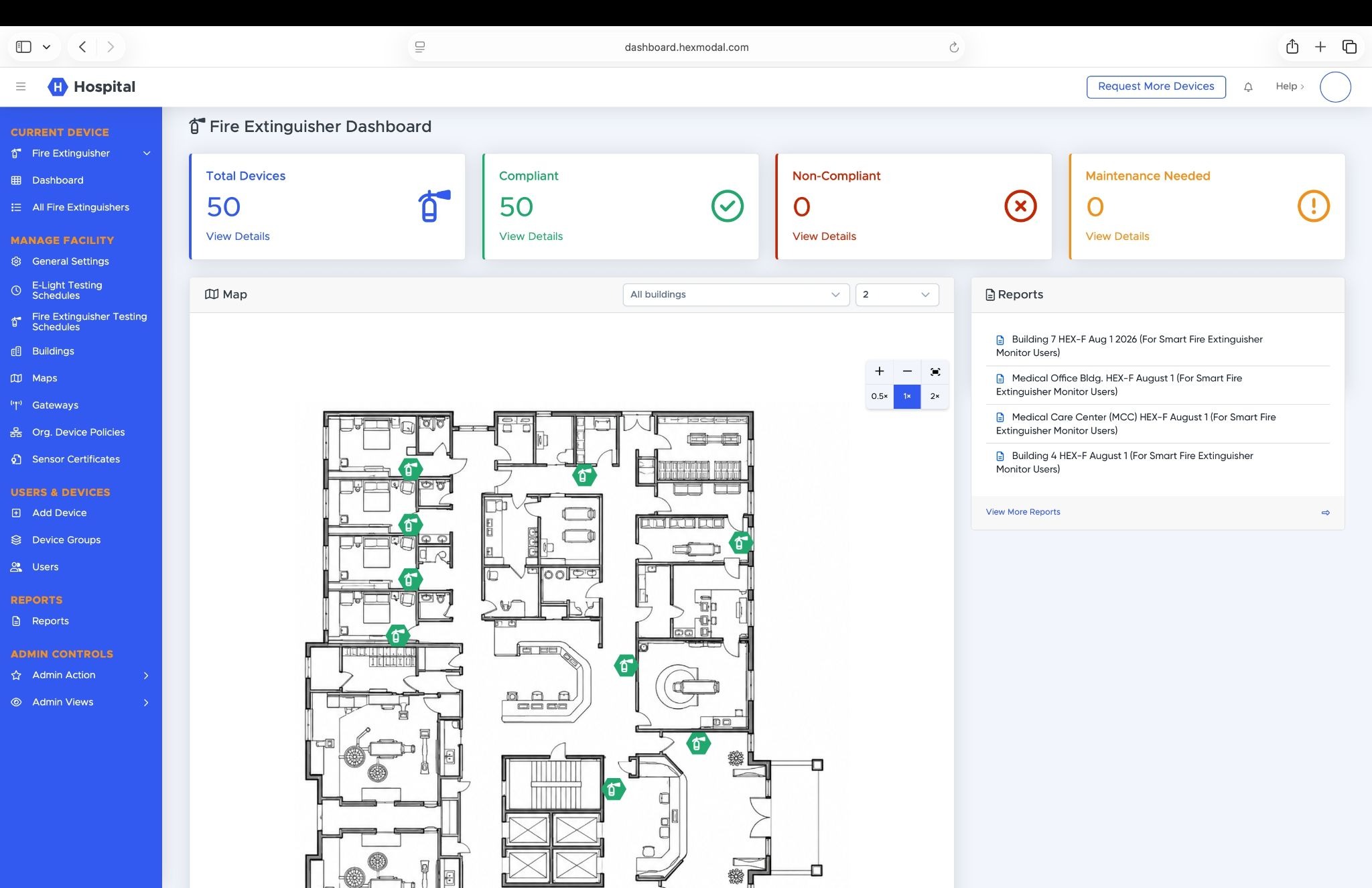
Send problems into your CMMS so each fix attaches to the original record. Hexmodal integrates with the major CMMS platforms used in healthcare facilities management, and the integration is optional.
A central dashboard changes your travel math. Compliant and noncompliant counts across sites let you confirm status at a remote clinic without driving there, then send someone when there is a real reason to go.
Picture your 2,000-device portfolio before and after. Today, the monthly round means someone walking corridors and back rooms twelve times a year, initialling tags, then rebuilding your history when a survey is announced. With monitoring approved and running, your devices do the rounds, your record appears as it happens, and a problem reaches the right person the day it shows up.
Hexmodal reports 3,800 or more facilities and 150,000 or more devices on the platform. AdventHealth reported a 55% cut in compliance testing costs. Atlantic Health reported more than 10,000 hours saved.
What Surveyors Ask For During a Fire Extinguisher Records Review
Your records review runs through five documents. Have all five in one place and you rarely spend long on this part of the survey.
- Twelve months of monthly inspection records.
- Your current annual service tag, with the agency name and address on it.
- The verification-of-service collar where your 6-year exam has come due.
- Your pressure test date.
- Paperwork on the fix for anything that failed.
Three gaps cause most findings. The first is a missing month, where a round got skipped or the record went astray. The second is an unreadable tag, where weather or handling has worn the entry away. The third is a record sitting with your vendor, which changes nothing, since responsibility stays with you as owner.
Continuous recordkeeping means your survey package is ready before the surveyor asks, and Hexmodal's 24/7 support can help you find a specific report mid-survey. Your annual, 6-year and pressure test records still come from your servicing agency and belong in the same file.
What Your Fire Extinguisher Inspection Program Comes Down To
Your program rests on four intervals. You must inspect every 31 days and bring in a certified technician once a year. Qualifying units need emptying and internal examination at six years, then a pressure test on a cycle set by their type. Each interval leaves a different record behind and a surveyor will ask for all of them, so the by-type table matters more than the four-tier picture once your inventory is mixed.
Monthly is the interval that comes around twelve times a year, and it is the only one you can automate. NFPA 10 lets you use electronic monitoring once your AHJ approves it in writing, and Hexmodal covers five of the seven monthly checks while building the record as each one happens. Everything else carries on as it is, in the hands of certified people.
If you want to see how that would work across your buildings, book a walkthrough with our team.
Frequently Asked Questions
1. What happens if you miss a monthly fire extinguisher inspection?
Your record gap stays in the file for twelve months. Do the inspection right away, write up the corrective action and log the date you finished. A surveyor treats a month with no record as an inspection that failed to happen, whatever shape the extinguisher was actually in.
2. Do fire extinguishers in vehicles or outdoor locations follow the same schedule?
You must check vehicle-mounted units more often, at the start of a shift or any time the vehicle is used. Your outdoor units often sit in corrosive air or extreme heat, which adds the three extra checks covered above.
3. Can you perform annual maintenance in-house instead of using a vendor?
Yes, with certified staff. Running your own service operation with trained people meets the rule. Your team must have the maker's service manual, the right tools and listed replacement parts for every extinguisher type you own.
4. Does a monitored extinguisher still need a physical tag?
No. You can pick one form of record: a tag, a checklist in a file or an electronic record. An approved monitoring system meets the rule on its own. Your annual service tag is a separate job and stays on the extinguisher.
5. What happens if your vendor loses your inspection records?
The responsibility stays with you. Inspection, service and recharging sit with the owner or the agent the owner names, regardless of who holds the paperwork. A surveyor writes the finding against your facility. Keep your own copy of every vendor record and you avoid the situation.
6. What does a rating like 4-A:20-B:C actually mean?
The number shows how well the unit performs against a standard test fire. A 4-A unit handles roughly four times the Class A fire a 1-A unit handles. The 20-B figure relates to square footage of flammable liquid fire. Class C carries no number.
Author:
Chris Hariz
Category:
Compliance
Date:
September 18, 2026
Keep reading
Related Articles

Schedule Your Demo
Demo request received
Someone from the team will be in touch shortly to schedule your demo.
Something Went Wrong
Your request couldn’t be submitted. Please try again or refresh the page.